
The effectiveness of a natural anti-aging product has less to do with the « miracle ingredient » on the label and more to do with its chemical stability, concentration, and ability to penetrate the skin.
- Ingredients like Bakuchiol can rival Retinol, but only at specific purity levels and after 8-12 weeks of consistent use.
- High percentages of actives like Niacinamide often offer no extra benefit, only increased irritation, as skin receptors become saturated.
Recommendation: Stop chasing trendy ingredients and start evaluating products based on their formulation science and clinical proof (in vivo studies, not just lab tests).
The promise of erasing wrinkles with gentle, plant-derived ingredients is alluring. But for anyone who has been disappointed by a « green » serum that did little more than smell nice, skepticism is a healthy starting point. From a clinical perspective, the gap between marketing claims and tangible results can be vast, leading to wasted money and continued frustration with fine lines, uneven texture, and loss of firmness.
The market is saturated with so-called « natural retinol alternatives. » We’re told Bakuchiol is the new hero, that Kakadu Plum is a Vitamin C powerhouse, and that natural oils are the key to hydration. These narratives are simple, appealing, and fit neatly on a product label. However, they often overlook the complex science required to make an active ingredient truly effective once it leaves the bottle and meets your skin.
But what if the focus on the ingredient itself is the mistake? The clinical reality is that an ingredient’s efficacy hinges on factors marketers rarely discuss: its molecular stability in the bottle, its molecular size’s ability to penetrate the skin barrier, and the specific concentration proven to work in human studies. An impressive ingredient that oxidizes on contact with air or sits uselessly on the skin’s surface is clinically worthless.
This article cuts through the marketing noise. We will dissect the science, comparing popular natural actives to their clinical counterparts, revealing which « proven results » are meaningful, and providing a framework to judge if your natural products are actually working. It’s time to move beyond the hype and focus on the evidence.
To navigate this complex landscape, we will break down the critical questions you should be asking about your natural skincare, from ingredient efficacy to realistic timelines and proper application.
Contents: The Clinical Evaluation of Natural Anti-Aging
- Is Bakuchiol really as effective as Retinol for collagen production?
- L-Ascorbic Acid vs. Kakadu Plum: Which stays potent longer in the bottle?
- In Vivo vs. In Vitro: Which « proven results » actually mean something?
- The molecular size mistake that prevents natural oils from hydrating deep layers
- 3 weeks: How long to wait before deciding a natural product doesn’t work?
- 10% vs 20% Niacinamide: Is stronger actually better value?
- Why Arbutin works better than Lemon Juice for safe brightening?
- Are You Wasting Money by Applying Your Vitamin C Serum Wrong?
Is Bakuchiol really as effective as Retinol for collagen production?
Bakuchiol is the most-hyped « natural retinol, » but its efficacy is not a given; it’s conditional. From a clinical standpoint, the comparison to retinol is surprisingly valid, but only under specific circumstances. The question isn’t just if it works, but how well it works and whether the product you’re buying meets the scientific standard.
The excitement is rooted in solid evidence. A landmark study directly compared bakuchiol and retinol in a 12-week clinical trial. The findings were significant: 12 weeks of treatment with bakuchiol showed significant improvement in lines, wrinkles, pigmentation, and firmness. Crucially, it achieved these results without the redness, stinging, and peeling commonly associated with retinoid therapy. This demonstrates that its mechanism, while different from retinol, can stimulate similar collagen-producing pathways in the skin.
However, this is where a discerning consumer must look deeper. The efficacy seen in studies is tied to the purity of the bakuchiol used. Industry standards clarify that for a product to be labeled with the INCI name « Bakuchiol, » it must have a purity of at least 99%. Formulations using less pure extracts can introduce photosensitizers and other irritants, undermining the primary benefit of being a gentle alternative. Therefore, a product simply listing « bakuchiol extract » without specifying its purity or source is a red flag. It may not deliver the clinical results you expect.
L-Ascorbic Acid vs. Kakadu Plum: Which stays potent longer in the bottle?
L-Ascorbic Acid (L-AA) is the most researched form of Vitamin C, a powerhouse antioxidant. Its fatal flaw, however, is its profound molecular instability. When exposed to air, light, or water, it rapidly oxidizes, turning brown and becoming not only ineffective but potentially pro-oxidant, causing the very damage it’s meant to prevent. This is why many L-AA serums have a frustratingly short shelf life after opening.
This is where botanical sources like Kakadu Plum present a fascinating alternative. While it’s impressive that the Kakadu plum contains up to 75 times more vitamin C than an orange, its real advantage isn’t just the concentration; it’s the delivery package. In its natural form, the Vitamin C within the plum is surrounded by a complex matrix of other antioxidants and phytochemicals, such as gallic and ellagic acids. This botanical synergy acts as a natural protective buffer, shielding the Vitamin C from premature oxidation.
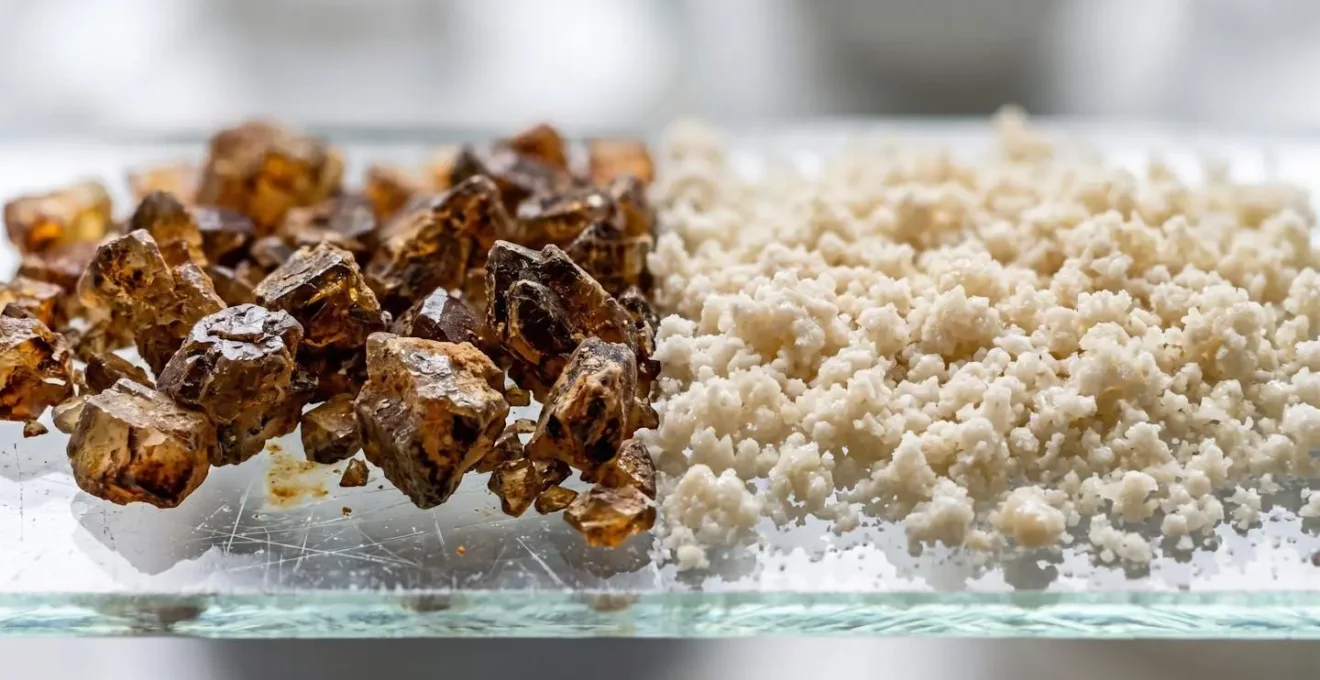
As the image above visually suggests, the difference is stark. While pure L-AA degrades into discolored, inactive crystals, the Vitamin C held within a botanical matrix remains more stable. A well-formulated product using a high-quality Kakadu Plum extract can therefore offer a more potent and longer-lasting antioxidant benefit than an improperly stabilized L-AA serum. The lesson is clear: for Vitamin C, stability is more important than the initial stated percentage.
In Vivo vs. In Vitro: Which « proven results » actually mean something?
The phrase « clinically proven » is one of the most misused terms in beauty marketing. To the skeptical consumer, it should immediately trigger a critical question: proven where? The difference between a result achieved in a petri dish versus on actual human skin is monumental. This is the distinction between in vitro and in vivo testing, and it is the ultimate litmus test for a product’s claims.
In vitro (« in glass ») studies are conducted in a controlled lab environment, typically on isolated cells or tissues in a petri dish. They are essential for initial research to see if an ingredient has any biological activity at all. For example, a lab test might show that an extract boosts collagen production in a skin cell culture. This is a promising start, but it’s a long way from proving it will work on a living, breathing person. The human skin has a complex barrier (the stratum corneum), an immune system, and is exposed to environmental factors that don’t exist in a dish.

In vivo (« within the living ») studies are the gold standard. These are tests conducted on human volunteers. A well-designed in vivo study will be double-blind and placebo-controlled, using instruments to measure objective changes in skin hydration, wrinkle depth, or elasticity over several weeks or months. When a brand claims its product « reduces wrinkles by 30%, » you must demand to see if this result came from an in vivo study. If the proof is only in vitro, the claim is, at best, a theoretical possibility, not a proven outcome for you, the end-user.
The molecular size mistake that prevents natural oils from hydrating deep layers
One of the most persistent myths in natural skincare is that applying oils directly to the skin provides deep hydration. From a biochemical standpoint, this is a fundamental misunderstanding of skin physiology and the definition of « hydration. » Hydration is the process of increasing the water content of cells. Oils are lipophilic (fat-loving) and water is hydrophilic (water-loving). They don’t mix.
The primary function of most natural oils in skincare is occlusion. Their large molecular size prevents them from penetrating deep into the dermis. Instead, they form a protective layer on the skin’s surface, which is incredibly valuable for slowing Transepidermal Water Loss (TEWL)—the process of water evaporating from your skin. This helps keep the skin’s existing water locked in, making it feel softer and more supple. But they do not, by themselves, add water to the deeper layers.
Oils (lipophilic) do not ‘hydrate’ (add water) deep layers. Their primary roles are occlusive (preventing Transepidermal Water Loss) and delivering oil-soluble actives.
– Cosmetic Science Researchers, Springer Nature – Comprehensive review of bakuchiol delivery systems
So how do you get beneficial, water-soluble natural ingredients (like many peptides or botanical extracts) into the skin? The key is a sophisticated delivery system. Modern cosmetic science uses clever techniques to overcome the skin’s lipid barrier. A comprehensive review in Phytochemistry Reviews confirms that advanced delivery systems like liposomes and nano-emulsions can shuttle water-soluble actives past this barrier. These systems encapsulate the active ingredient inside a lipid-friendly shell, effectively smuggling it through the skin’s oily outer layers to where it can be effective.
3 weeks: How long to wait before deciding a natural product doesn’t work?
In a world of instant gratification, waiting for skincare to work is a difficult test of patience. Many consumers abandon a new product after two or three weeks if they don’t see transformative results, assuming it’s ineffective. This is often a critical error, especially with ingredients designed to produce structural changes in the skin, like stimulating collagen.
The timeline for results is dictated by the ingredient’s mechanism of action and the skin’s own biological clock. The average skin cell turnover cycle—the time it takes for new cells to form at the deepest layer of the epidermis and travel to the surface to be shed—is about 28 days for a young adult and can slow to 45-60 days with age. Ingredients that work by influencing this cycle, such as bakuchiol, need time to have an effect. Indeed, dermatology experts confirm that 6 to 12 weeks of regular bakuchiol use is required to see visible improvements in texture and fine lines. Quitting at week three means you’ve given up before the first full cycle of renewal has even completed.
Not all ingredients work on the same timeline. Anti-inflammatory actives like chamomile can reduce redness in a matter of days. But for anti-aging results that depend on rebuilding the skin’s matrix, patience is non-negotiable. Judging a collagen-stimulator by the same standard as a calming ingredient is a recipe for disappointment and a cabinet full of half-used, effective products.
Your Action Plan: Auditing Your Natural Skincare Routine’s Efficacy
- Identify the Active & Its Job: List the primary active ingredient (e.g., Bakuchiol) and its specific goal (e.g., reduce fine lines). Is the product designed for this purpose?
- Check the Timeline: Cross-reference the active with its known efficacy timeline (e.g., 8-12 weeks for collagen stimulators). Are you being patient enough?
- Assess Consistency & Usage: Review your daily application. Are you using it as directed (AM/PM, on clean skin) without skipping days? Inconsistent use will always yield poor results.
- Isolate the Variable: Are you using multiple new products at once? Pause other new actives to accurately attribute results (or irritation) to this specific product.
- Document the Evidence: Take weekly, makeup-free photos in the same lighting to track subtle changes objectively. Your memory is an unreliable narrator; photos are data.
10% vs 20% Niacinamide: Is stronger actually better value?
Niacinamide (Vitamin B3) is a versatile, well-tolerated active celebrated for its ability to improve barrier function, regulate sebum, and reduce hyperpigmentation. In a classic case of marketing-driven escalation, brands have launched increasingly high concentrations, moving from 5% to 10%, and now even 20% serums. The implicit promise is that stronger is better. However, skin science reveals a point of diminishing returns.
The concept of receptor saturation is key. Your skin cells have specific receptors that bind with niacinamide to initiate its beneficial processes. Once these receptors are fully occupied, or saturated, adding more of the ingredient doesn’t produce a greater effect. It’s like having a full parking lot; sending more cars won’t get more people into the building. Instead, the excess active sits on the skin, increasing the risk of irritation, redness, and sensitivity without providing additional value.
Clinical evidence supports this. Most of the proven benefits of niacinamide, such as improving skin texture and reducing red blotchiness, were established in studies using concentrations between 2% and 5%. Higher concentrations up to 10% can be effective for more stubborn issues like enlarged pores and significant pigmentation. Beyond that, the science is sparse. In fact, dermatological research demonstrates that skin receptors for niacinamide become saturated beyond a 5-10% concentration, with minimal additional benefit but an exponentially increased risk of irritation. A 20% formulation is not « twice as good » as a 10% one; it is primarily twice as likely to cause a reaction in sensitive individuals.
The table below, based on clinical consensus, outlines the optimal use for each concentration tier. For the vast majority of users, a well-formulated 5-10% niacinamide serum represents the sweet spot for efficacy and tolerability.
| Concentration | Primary Benefit | Optimal Use Case | Irritation Risk |
|---|---|---|---|
| 2-5% | Barrier support & general health | Daily maintenance, sensitive skin | Very Low |
| 5-10% | Sebum regulation & pigmentation | Acne-prone, uneven tone | Low to Moderate |
| 10-20% | Clinical intervention for stubborn concerns | Severe hyperpigmentation (dermatologist guidance) | Moderate to High |
Why Arbutin works better than Lemon Juice for safe brightening?
The DIY trend of using lemon juice to lighten dark spots is one of the most dangerous and scientifically unsound pieces of beauty advice. It stems from a simplistic association: lemons contain citric acid (an AHA) and Vitamin C, both known for brightening effects. However, applying raw lemon juice to the skin is a recipe for barrier damage and photosensitivity.
The problem is one of chemistry and safety. According to the Journal of Integrative Dermatology, lemon juice’s extremely low pH of around 2.0 violently disrupts the skin’s acid mantle, which should be around pH 5.5. This chemical burn compromises barrier function, leading to inflammation and dehydration. Worse, compounds in citrus called furocoumarins can cause a severe phototoxic reaction known as phytophotodermatitis when skin is exposed to UV light, resulting in painful blisters and even worse hyperpigmentation than you started with.
A clinically sound natural alternative is Arbutin, often derived from the bearberry plant. It works through an elegant and controlled mechanism. As cosmetic researchers explain, Arbutin is a molecule of hydroquinone (a potent but potentially irritating skin-lightener) attached to a sugar molecule. This bond makes it stable and gentle. When absorbed, enzymes in the skin slowly cleave the sugar molecule, releasing the hydroquinone gradually and deep within the epidermis where melanin is produced. This targeted, slow-release action inhibits the tyrosinase enzyme responsible for dark spots, effectively brightening the skin from within while minimizing the surface irritation associated with both lemon juice and pure hydroquinone.
Arbutin is essentially a molecule of hydroquinone attached to a sugar molecule. This makes it stable and safe for the skin to absorb, only releasing its potent brightening agent deep within the skin where it’s needed, minimizing surface irritation.
– Cosmetic Dermatology Researchers, Journal of Integrative Dermatology
Key takeaways
- Efficacy depends on formulation, not just the ingredient. Look for evidence of stability (e.g., opaque packaging for Vitamin C) and smart delivery systems (liposomes).
- Patience is non-negotiable. Collagen-stimulating ingredients like Bakuchiol require a minimum of 8-12 weeks to show visible results, aligned with the skin’s natural cell turnover cycle.
- Concentration is a balancing act. More is not always better. Optimal ranges (like 5-10% for niacinamide) often provide peak benefits with minimal irritation risk.
Are You Wasting Money by Applying Your Vitamin C Serum Wrong?
Even the most expensive, well-formulated natural Vitamin C serum is a waste of money if applied incorrectly. The timing and order of application are not minor details; they are critical factors that determine whether the active can perform its primary function: providing antioxidant protection against environmental aggressors.
The single most important function of a topical Vitamin C serum is to create an antioxidant reservoir in the skin. When applied in the morning, it neutralizes free radicals generated by UV radiation and pollution throughout the day, working in synergy with your sunscreen to provide comprehensive protection. This protective effect is remarkably long-lasting. Research on topical vitamin C mechanisms confirms that when applied in the AM, it builds up in the skin, providing protection for up to 72 hours. Applying it at night misses this key daytime defensive opportunity.
Furthermore, the efficacy of L-Ascorbic Acid, the most common form, is highly pH-dependent. It needs a low pH environment to penetrate the skin effectively. Applying it after other products, especially moisturizers or oils, will buffer its pH and severely inhibit its absorption, rendering it far less effective. To get the full value from your investment, follow a strict protocol.
- Step 1: Apply L-Ascorbic Acid serum as the very first product on clean, completely dry skin for maximum pH-dependent efficacy.
- Step 2: Wait a minimum of 60 seconds for the water-based serum to fully penetrate and the pH to normalize before layering any other products.
- Step 3: Always apply in the AM, not PM, to build the antioxidant reservoir that provides crucial environmental protection throughout the day.
- Step 4: Always follow with a broad-spectrum SPF 30 or higher. Sunscreen and Vitamin C work synergistically to provide superior protection against photodamage.
Stop guessing and start analyzing. Use this clinical framework to audit your current routine and invest only in natural products backed by transparent science and proven formulation.