
Contrary to popular belief, a « recyclable » or « organic » label doesn’t automatically make a beauty product sustainable; it’s often the starting point for a much deeper investigation.
- Many « sustainable » choices involve complex trade-offs, such as certified palm oil having higher land efficiency but a controversial history of deforestation.
- Hidden impacts in the supply chain, like the carbon footprint of shipping organic ingredients globally, can negate the benefits of the ingredient itself.
Recommendation: Adopt a « lifecycle audit » mindset. Scrutinize every stage of a product’s life—from raw material and water usage to marketing and disposal—to make truly informed decisions.
The term « sustainable beauty » is everywhere, decorating bottles and boxes with calming green leaves and bold eco-claims. We’re encouraged to seek out recyclable packaging, natural ingredients, and cruelty-free logos. These are presented as simple checkboxes on the path to a more ethical routine. But this surface-level approach often obscures more significant environmental impacts, creating a landscape ripe for greenwashing where consumers feel good about choices that may not be as beneficial as they seem. It distracts from deeper questions about water footprints, supply chain ethics, and the systemic pressure to consume.
This is where the role of a consumer must evolve from a passive buyer to a critical auditor. What if the most impactful action wasn’t just choosing a product with a green label, but learning to question what that label truly represents? The inconvenient truth is that genuine sustainability is rarely simple. It’s a world of complex trade-offs, hidden footprints, and systemic challenges that a pretty logo cannot fully capture. The key isn’t to find the « perfect » product—it’s to develop the critical thinking skills to evaluate the entire lifecycle of what we buy.
This guide moves beyond the marketing claims. We will dissect the most common pillars of « green » beauty, from ingredient sourcing and water usage to the psychological traps of « self-care » marketing and the hard realities of recycling. The goal is to equip you with an auditor’s mindset, enabling you to see past the packaging and make choices that have a real, measurable positive impact.
To navigate this complex topic, we will break down the core components of a true beauty audit. The following sections will guide you through scrutinizing certifications, product formulations, ingredient dilemmas, and end-of-life realities, providing a clear framework for your own evaluation.
Summary: A Critical Guide to Unpacking Sustainable Beauty Claims
- Ecocert vs. Leaping Bunny: Which logo guarantees no animal testing?
- Why solid bars save gallons of water compared to liquid shampoos?
- Sustainable Palm Oil vs. Palm-Free: Which is better for rainforests?
- The carbon footprint mistake of buying « organic » ingredients shipped from halfway across the world
- 3 bathroom items you are recycling wrong that contaminate the bin
- The « Self-Care » marketing trap that costs you money without bringing peace
- Coffee Grounds and Fruit Pits: How waste becomes exfoliant?
- How to Vote With Your Wallet Against Unethical Beauty Practices?
Ecocert vs. Leaping Bunny: Which logo guarantees no animal testing?
One of the most visible claims in ethical beauty is « cruelty-free. » Consumers often assume any bunny logo means a product is free from animal testing. However, from an auditor’s perspective, the rigor behind these certifications varies dramatically. The key difference lies not in the logo, but in the verification process. Some well-known certifications may only require brands to sign a written agreement stating they don’t test on animals, relying on an honor system. This leaves room for loopholes, especially regarding ingredients sourced from third-party suppliers.
In contrast, the Leaping Bunny Program is widely considered the gold standard for a crucial reason: it requires a thorough and ongoing audit. As their own program states, it provides a guarantee based on stringent verification.
The Leaping Bunny Program offers not just a list, but a Standard—the only Standard that guarantees a product to be free of new animal testing.
– Leaping Bunny Program, Leaping Bunny Frequently Asked Questions
To earn this certification, a brand must not only pledge against animal testing but also implement a supplier monitoring system and submit to independent audits for ongoing verification. This ensures that no part of the supply chain—from individual ingredients to the final product—involves new animal testing. Certifications like Ecocert, while valuable for verifying organic ingredients, do not have the same singular, rigorous focus on the entire supply chain’s cruelty-free status. A true audit, therefore, means looking past the bunny image and verifying the method of certification.
Why solid bars save gallons of water compared to liquid shampoos?
The focus on packaging often overshadows a much larger issue hidden in plain sight: water. Most traditional liquid beauty products, from shampoos and conditioners to lotions and cleansers, have a surprisingly high water content. According to the sustainability platform Provenance, « Most traditional skincare formulations contain between 60% and 80% water. » This means a significant portion of the product’s volume and weight is simply H₂O, which has two major environmental consequences: larger, heavier packaging and a higher carbon footprint from transportation.
This is where solid, or « waterless, » formulations represent a fundamental shift in product design. By removing water, manufacturers can create highly concentrated bars that deliver active ingredients without the filler. A single solid shampoo bar can often replace two to three standard plastic bottles, drastically reducing plastic waste. More importantly, it slashes the product’s water footprint before it even reaches your home.
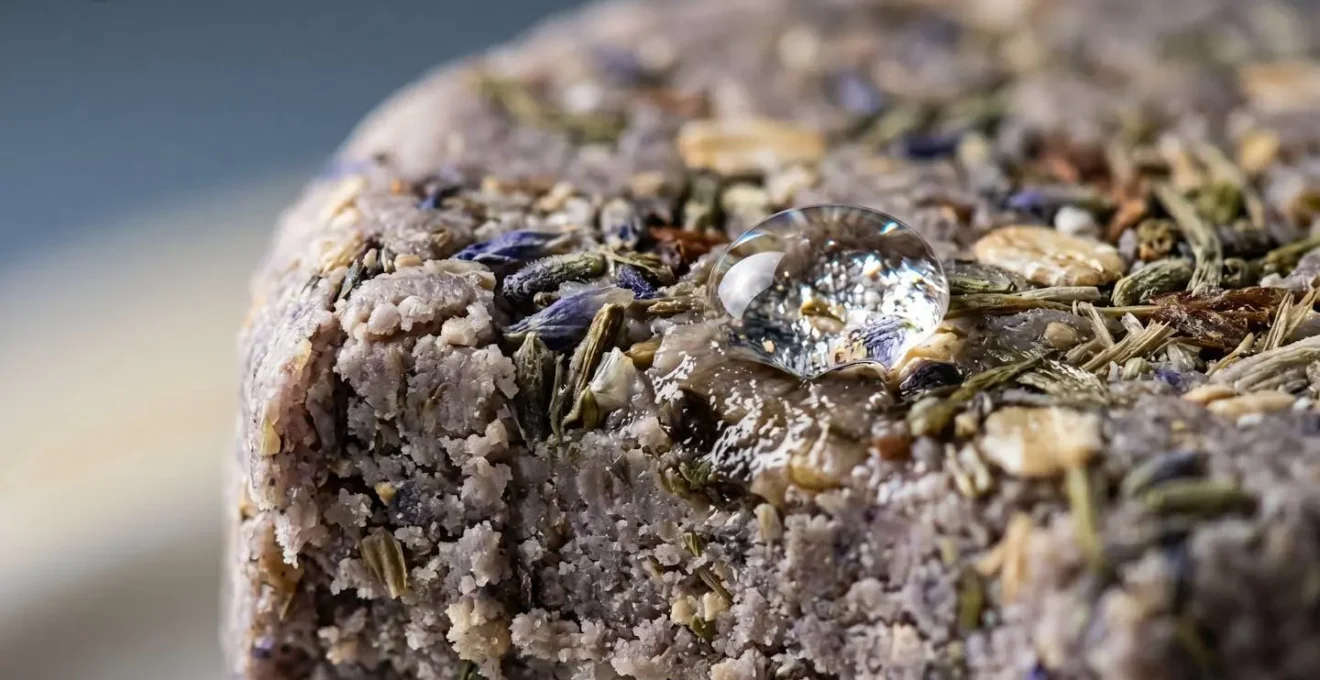
As the image above illustrates, the very nature of a solid bar is its density. It’s a compressed block of cleansing agents and nourishing oils, activated by the water already in your shower. This shift not only tackles the plastic problem but also addresses the less visible, yet highly impactful, issues of resource depletion and transport emissions. Opting for solid formulations isn’t just about reducing packaging; it’s about refusing to pay for and ship water across the country.
Sustainable Palm Oil vs. Palm-Free: Which is better for rainforests?
Palm oil is one of the most controversial ingredients in the beauty industry, inextricably linked to images of deforestation and habitat loss for endangered species like orangutans. The intuitive response for a conscious consumer is to boycott it entirely, opting for « palm-free » products. However, an auditor’s job is to look at the complete data, and the reality of palm oil is a complex trade-off.
The primary issue with a blanket boycott is that palm oil is an incredibly efficient crop. Conservation research demonstrates that palm oil produces up to 9 times more oil per unit area than other major oil crops like soy or rapeseed. A complete shift away from palm oil would require significantly more land to produce the same amount of vegetable oil, potentially shifting the deforestation problem elsewhere. This is why many conservation groups advocate for supporting Certified Sustainable Palm Oil (CSPO) instead of a total boycott. Data from the Roundtable on Sustainable Palm Oil (RSPO) suggests that certified palm oil has a 20% lower biodiversity impact from land-use changes compared to non-certified options.
However, even CSPO is not a perfect solution. The certification has faced valid criticism for its limitations and historical failings, which a thorough audit must acknowledge.
Case Study: The RSPO Certification and Historical Deforestation
A revealing analysis using satellite imagery, reported by Mongabay, found that vast areas of Indonesian and Bornean rainforests were converted to palm oil plantations *before* the RSPO certification system was widely implemented. These plantations were later certified as « sustainable » in the 2000s, despite being established on land that was recently primary forest. This exposes a critical flaw: certification can sometimes legitimize historical deforestation. This raises a difficult question for consumers: is it better to support a flawed-but-improving certification system to protect remaining ecosystems and smallholder farmers, or to boycott the ingredient entirely and risk shifting demand to less efficient, land-hungry oils?
The choice between « sustainable palm oil » and « palm-free » is not a simple good vs. evil scenario. It’s a decision based on weighing land-use efficiency against certification integrity and historical environmental damage.
The carbon footprint mistake of buying « organic » ingredients shipped from halfway across the world
The « organic » label is another cornerstone of conscious consumerism, often equated with being inherently better for the planet. On the farm level, this holds true. Organic farming practices avoid synthetic pesticides and fertilizers, promoting healthier soil ecosystems. In fact, sustainable beauty brand data shows that certified organic ingredients help sequester an average of 3.5 tonnes of extra CO2 per hectare compared to conventional farming. This is a significant environmental win. However, a product’s lifecycle doesn’t end at the farm.
The major blind spot in the « organic is always better » argument is the carbon footprint of transportation. A beauty product formulated with organic lavender from France, shea butter from Ghana, and marula oil from Namibia may have an impeccable ingredient list, but the air miles required to bring those components to a factory and then to your doorstep can be enormous. In some cases, the emissions from shipping can outweigh the environmental benefits gained from the organic farming method itself. A locally-grown, conventionally-farmed ingredient might have a lower overall carbon footprint than an exotic organic one shipped by air.
This doesn’t mean organic is bad. It means we must add another layer to our audit: geography. As a conscious consumer, the questions we ask must evolve.
If brands are proudly shipping ingredients from all over the world but haven’t thought about carbon offsetting, it’s absolutely right to ask them why.
– Laura Broadfield, SUST Edit Founder, The Difficult Truth About ‘Natural’ Beauty Products & Climate Change
An auditor looks for brands that are transparent not just about their ingredients, but about their entire supply chain. Do they prioritize local sourcing? Do they use sea freight over air freight? Do they invest in carbon offsetting programs to mitigate the impact of their global logistics? An organic certification is a positive data point, but it’s incomplete without an audit of the product’s journey.
3 bathroom items you are recycling wrong that contaminate the bin
The final stage of a product’s lifecycle—disposal—is where many consumers feel they are making a positive impact. We diligently rinse our plastic bottles and toss them in the recycling bin, confident we’ve done our part. But the reality is that the beauty industry is a major contributor to the plastic crisis, producing around 120 billion units of packaging each year, much of which is fundamentally non-recyclable due to its design.
This is where an audit of your own recycling habits becomes crucial. Good intentions can inadvertently lead to « wish-cycling »—placing items in the bin hoping they’ll be recycled, when in fact they contaminate the entire batch, forcing it all to be sent to a landfill. Many common beauty product components are not processable by standard municipal recycling facilities (MRFs). Here are some of the most common culprits:
- Pump Dispensers: These are a classic example of mixed-material contamination. The plastic tube and nozzle are attached to a metal spring. Unless you completely disassemble the pump to separate the metal from the plastic (which is often impossible), the entire unit is considered trash by sorting machines.
- Black Plastic Containers: While the plastic type (like PET or HDPE) might technically be recyclable, the color itself poses a problem. Most recycling facilities use optical sorters that use light to identify and separate plastics. Black plastic absorbs this light, making it invisible to the machines. As a result, it is almost always sorted out and sent to a landfill.
- Products with Residue: A half-empty bottle of thick conditioner or lotion contaminates the recycling stream. The leftover product can ruin entire batches of paper or cardboard recyclables and clog machinery. Containers must be completely empty and rinsed to be viable for recycling.
Understanding these limitations is key to effective recycling. It shifts the responsibility from simply sorting to making better purchasing decisions in the first place, such as choosing products with simpler, single-material packaging or participating in brand-specific take-back programs like those offered by TerraCycle for complex packaging.
The « Self-Care » marketing trap that costs you money without bringing peace
Beyond ingredients and packaging, a full sustainability audit must examine the marketing messages that drive our consumption habits. The modern beauty industry has brilliantly co-opted the language of « self-care, » framing the purchase of new products as an act of wellness, mindfulness, and personal restoration. A 10-step skincare routine is no longer just a routine; it’s a therapeutic ritual. A new face mask isn’t just a product; it’s an essential tool for de-stressing.
While taking time for oneself is genuinely important, this marketing narrative creates a dangerous link between well-being and consumption. It fosters the idea that peace and contentment can be bought, leading to an endless cycle of purchasing more « stuff » to solve internal feelings of stress or inadequacy. This directly fuels overconsumption, the very antithesis of sustainability. As experts at the Wonther Sustainability Platform note, « The beauty industry has perpetuated this idea of continuous consumption. » True self-care—like rest, time in nature, or connecting with loved ones—is often free and requires no product at all.

The most sustainable beauty habit is often the one you don’t start. It’s about questioning whether you truly need another serum or if you’re being influenced by a marketing message that conflates purchasing with peace. This is the essence of « skinimalism »—a minimalist approach focused on using fewer, better products that serve a real function, rather than collecting an arsenal of items for every conceivable micro-need. It’s about finding contentment in « enough » rather than constantly seeking « more. » An audit of your own motivations can reveal how much of your consumption is driven by genuine need versus a manufactured desire for a quick fix.
Coffee Grounds and Fruit Pits: How waste becomes exfoliant?
While reducing consumption is critical, another powerful pillar of sustainable innovation lies in the principles of a circular economy. Instead of the traditional linear « take-make-dispose » model, a circular approach seeks to eliminate waste by turning by-products into valuable new resources. In the beauty industry, this is most excitingly demonstrated through the trend of « upcycled » ingredients.
This process, known as ingredient valorization, involves taking waste streams from other industries—predominantly the food and beverage sector—and transforming them into high-performance cosmetic ingredients. What was once destined for landfill becomes a functional part of a new product. Common examples include using discarded coffee grounds as a natural exfoliant, extracting nutrient-rich oil from fruit seeds left over from juice production, or using olive pits and apricot kernels as gentle scrubbing agents. This approach not only diverts waste but also reduces the environmental strain of farming and harvesting virgin ingredients specifically for cosmetics.
Case Study: Graydon Skincare’s Upcycled Seed Oils
The brand Graydon Skincare provides a perfect example of industrial upcycling. They source raspberry and blueberry seeds that are by-products of the local Canadian juicing industry. These seeds, which would otherwise be discarded, are collected and cold-pressed to extract potent, antioxidant-rich oils. This transforms food waste into a premium, functional ingredient for their skincare formulations. This process highlights how professional upcycling differs from simple DIY remedies by ensuring ingredient safety, stability, and efficacy through proper extraction and processing, turning a waste product into a cornerstone of a luxury cream.
As beauty industry expert Marine Capron notes, this shift towards circularity, alongside waterless formulations, represents a major wave in zero-waste beauty. It’s a tangible way brands can reduce their overall footprint. For a consumer-auditor, seeking out brands that proudly and transparently feature upcycled ingredients is a powerful way to support a more resourceful and less wasteful industry.
Key takeaways
- True sustainability requires auditing the entire product lifecycle, not just trusting a green label.
- Many « eco-friendly » choices involve complex trade-offs, like the land-use efficiency of palm oil versus its link to deforestation.
- Your power as a consumer lies in asking critical questions about supply chains, water usage, and end-of-life realities before you buy.
How to Vote With Your Wallet Against Unethical Beauty Practices?
After dissecting the complexities of certifications, ingredients, and marketing, the final step is to consolidate this knowledge into a practical framework for action. Voting with your wallet is not about achieving perfection, but about making informed, intentional choices that signal a demand for greater transparency and responsibility. A 2021 consumer survey found that 58% of consumers want companies to be more transparent about their environmental impact, and your purchasing decisions are the most direct way to reinforce that demand.
Becoming a sustainability auditor of your own beauty routine means moving beyond impulse buys and applying a consistent set of criteria to every potential purchase. It’s about building a habit of investigation. To do this effectively, you need a clear, repeatable checklist to evaluate brands and products against the principles we’ve discussed. This isn’t about finding brands that tick every single box—those are exceedingly rare. It’s about identifying brands that are genuinely trying, are transparent about their shortcomings, and are making measurable progress on the issues that matter most to you.
The following checklist is your practical tool for conducting this audit. Use it to scrutinize potential purchases and build a routine that aligns with your values, pushing the industry toward a more accountable future.
Your Brand Audit Checklist: 5 Points to Verify
- Ingredient Supply Chain Transparency: Can the brand trace its key ingredients back to the source? Do they provide evidence of ethical sourcing and fair labor practices?
- Third-Party Certifications: Look for rigorous, audited certifications. Prioritize Leaping Bunny for cruelty-free, and look for others like B-Corp (for overall social and environmental performance) or Fair Trade.
- Synthetic Ingredient Safety: If synthetic ingredients are used, does the brand confirm they are biodegradable and non-toxic to aquatic ecosystems?
- Carbon Offsetting Practices: For brands shipping globally, do they demonstrate clear carbon offset programs, use of renewable energy, or a commitment to localized supply chains?
- Packaging Circularity: Does the brand offer a clear path for its packaging’s end-of-life? Prioritize those with established take-back programs, accessible refill systems, or simple, single-material packaging that is genuinely recyclable in your area.
Start today by auditing a single product on your shelf against this checklist. This small act of investigation is the first step toward building a truly sustainable beauty practice that values transparency over trends.