
The secret to flattering your body isn’t about fitting into a « shape » category; it’s about mastering the universal, architectural principles of proportion.
- Instead of focusing on body types like ‘apple’ or ‘pear’, focus on creating balance and guiding the eye with techniques like the Rule of Thirds.
- Understanding how fabric, hemlines, and small styling details like a simple tuck can fundamentally alter a silhouette is more empowering than following rigid rules.
Recommendation: Start thinking of your outfits as architectural compositions. Analyze where lines fall and how volumes interact, rather than just what garments you’re wearing.
For many women, the cycle is frustratingly familiar. A new trend emerges—oversized blazers, wide-leg trousers, low-rise jeans—and the pressure mounts to participate. Yet, trying these styles often leads to feeling lost, frumpy, or like you’re hiding in your own clothes. The common advice is to « dress for your body shape, » a process that usually involves categorizing yourself as a piece of fruit—an apple, a pear, an hourglass. While well-intentioned, this approach can feel restrictive and often fails to account for the beautiful diversity of human anatomy.
What if the problem isn’t your body, but the rules themselves? The most stylish individuals don’t just follow prescriptive guides; they understand the fundamental, architectural principles of clothing. They think in terms of proportion, balance, visual weight, and the lines they create on the body. This is a far more empowering and creative approach. It’s not about hiding perceived « flaws » but about skillfully sculpting a silhouette that feels authentic and confident, regardless of the trend of the moment or the label you’ve been given.
This guide moves beyond the fruit salad analogy. We will explore the technical concepts that stylists use to create proportional harmony. By mastering these foundational principles, you can learn to adapt any trend to your unique frame and finally build a wardrobe that works *for* you, not against you. It’s time to stop hiding and start styling with intention.
This article will provide a clear roadmap to understanding these core concepts. From the mathematical precision of the Rule of Thirds to the subtle power of a hemline, you’ll gain the tools to analyze and build outfits with an expert eye.
Summary: How to Dress for Your Body Shape Without Hiding Under Baggy Clothes?
- Why the « Rule of Thirds » changes how you look in photos?
- How to balance oversized tops with fitted bottoms for a structured look?
- A-Line vs. Pencil Skirt: Which shape creates the illusion of an hourglass?
- The hemline error that cuts your legs in half visually
- When to transition from bodycon to structured tailoring as you mature?
- How to balance an oversized blazer with the right footwear?
- Why the « French Tuck » changes the silhouette of a simple look?
- What Shoes Should You Wear With Wide-Leg Trousers to Avoid Dragging Hems?
Why the « Rule of Thirds » changes how you look in photos?
The « Rule of Thirds » is one of the most powerful concepts in all visual arts, from photography to painting, and fashion is no exception. It’s an architectural principle that dictates how to create a visually pleasing and harmonious composition. Instead of dividing your body in half (e.g., a top and bottom of equal visual length), you aim for an unequal division. The most effective way to do this is to create a visual break at either the one-third or two-thirds point of your body. This creates a more dynamic and elongated silhouette that is naturally more appealing to the human eye.
This isn’t just an abstract idea; it’s rooted in principles of design that value asymmetry and dynamic balance. According to an analysis of the Golden Ratio principle adapted to fashion, a 1/3 to 2/3 ratio creates a visually pleasing division that the brain processes as balanced and intentional. Wearing a top that ends exactly at your hips and trousers that cover the other half creates a static, 50/50 split that can make you look shorter and wider. By tucking in your shirt with high-waisted pants, you create a 1/3 top to 2/3 bottom ratio, instantly making your legs appear longer.
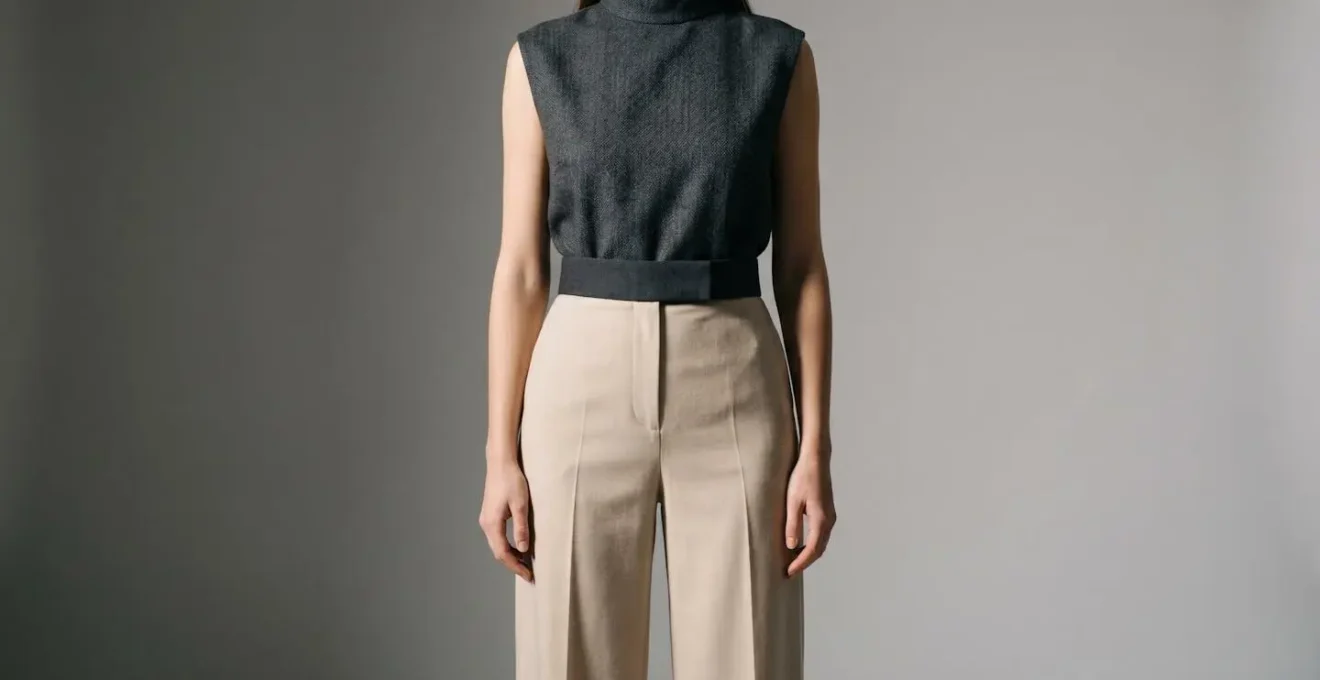
As seen in the image, color blocking is an excellent way to enforce this rule. Using a darker top tucked into lighter bottoms clearly defines that proportional harmony. You can achieve this effect in multiple ways: a cropped jacket over a longer dress, a longline cardigan over a shorter top and trousers, or using a belt to create a new, higher waistline. Mastering this single rule is the first step to moving from simply wearing clothes to consciously building a silhouette.
How to balance oversized tops with fitted bottoms for a structured look?
The oversized trend is a perfect example of where the « dress for your body type » rules break down and where understanding visual weight becomes essential. The key to wearing voluminous pieces without feeling overwhelmed is not to avoid them, but to balance them. When you wear an item with a lot of volume, like an oversized sweater or blazer, you are adding significant visual weight to one part of your body. To maintain a structured and intentional silhouette, you must counterbalance that volume with a more fitted, streamlined piece elsewhere.
Think of it as a dialogue between fabrics and shapes. An oversized, chunky knit sweater paired with sleek, fitted leggings or skinny jeans creates a beautiful contrast. The bulk of the sweater is anchored by the slim line of the pants, ensuring the overall look feels deliberate and chic, not sloppy. Conversely, pairing an oversized top with equally baggy trousers can quickly erase your shape and lead to a frumpy appearance, unless done with extreme precision and attention to fabric drape.
Case Study: The Fabric Dialogue Matrix
The success of an oversized look is not just about size, but proportion. An analysis of modern oversized styling reveals that the most successful outfits pair larger tops with smaller bottoms, such as an oversized jacket with a fitted mini skirt or tailored shorts. This combination works because it maintains the body’s natural proportions while still embracing the relaxed fit of the oversized piece. Crucially, the best results often come from sizing up just one or two sizes in a standard-fit garment rather than choosing an item explicitly designed to be extremely large, which can create a boxy, unflattering shape. This approach ensures the garment has the right shoulder and arm length while providing the desired volume.
This principle of balancing volume is universal and works for every body. It’s not about being a certain size to « pull off » an oversized look; it’s about being a smart stylist who understands how to manage proportion. By pairing your favorite cozy, oversized top with a sleek bottom, you are creating a look that is both comfortable and structurally sound.
A-Line vs. Pencil Skirt: Which shape creates the illusion of an hourglass?
Skirts are powerful architectural tools in a wardrobe. Their shape can dramatically alter your silhouette, and the choice between an A-line and a pencil skirt is a perfect lesson in how to consciously sculpt your shape. Neither is inherently « better »; they simply serve different functions. The key is to understand what each geometry does and deploy it to achieve your desired effect. The goal for many is the classic hourglass figure, which is defined by a balanced bust and hips with a clearly defined waist. Both skirt shapes can help achieve this, but they do so in opposite ways.
The pencil skirt is form-fitting, hugging the body from the waist to the knees. For bodies that already have curves through the hips (like pear or hourglass shapes), a high-waisted pencil skirt is a powerful tool to accentuate them. It follows the natural line of the body, celebrating its shape and creating a sleek, elongated lower half. The A-line skirt, conversely, is narrow at the waist and flares out, creating the shape of the letter ‘A’. This adds visual weight and volume to the lower body. For body shapes that are straighter or wider on top (like rectangular or inverted triangle shapes), an A-line skirt is transformative. It creates the illusion of fuller hips, which in turn makes the waist appear smaller, manufacturing an hourglass silhouette from a different starting point.
The following table breaks down how each skirt type interacts with different body morphologies to achieve specific styling goals. It’s not about a « right » or « wrong » choice, but an informed one based on the effect you want to create, as detailed in a comparative guide on skirt shapes.
| Skirt Type | Silhouette Effect | Best for Body Type | Key Feature | Styling Goal |
|---|---|---|---|---|
| Pencil Skirt | Form-fitting, hugs curves from hips to knees | Hourglass, Pear-shaped | High waistline, stretchy materials | Accentuates curves, elongates legs, creates structured professional vibe |
| A-Line Skirt | Flared, wider at bottom creating A-shape | Rectangular, Inverted Triangle | Looser fit, can be high or low-waisted | Adds volume to hips, creates illusion of curves, balances broader shoulders |
| Both Work | Depends on rise and fabric | Apple-shaped with adjustments | High-waisted versions elongate | Create balanced silhouette, strategic waist definition |
Ultimately, the choice depends on your starting point and your goal. Do you want to celebrate existing curves or create new ones? Answering that question will tell you exactly which architectural tool to pull from your wardrobe.
The hemline error that cuts your legs in half visually
Of all the details in an outfit, the hemline is one of the most critical and most frequently overlooked. Where the fabric of your skirt, dress, or trousers ends creates a powerful horizontal line. If that line falls at the wrong place, it can visually interrupt the vertical flow of your body and make your legs appear shorter and wider. The most common and unforgiving hemline error is a length that ends directly at the widest part of your calf. This is what stylists call a « danger zone » for proportion.
Why is this so problematic? Placing a strong horizontal line at the thickest point of your lower leg does two things: it draws the eye directly to that spot, and it visually severs the leg line, creating two shorter segments. Professional styling research consistently shows that a hemline hitting at the mid-calf at its widest part visually shortens the legs, disrupting the overall harmony of the silhouette. The most flattering hemlines, by contrast, fall at narrower points: just above or below the knee (the slimmest part of the leg’s mid-section) or much longer, near the ankle, which creates a continuous, elongating line.
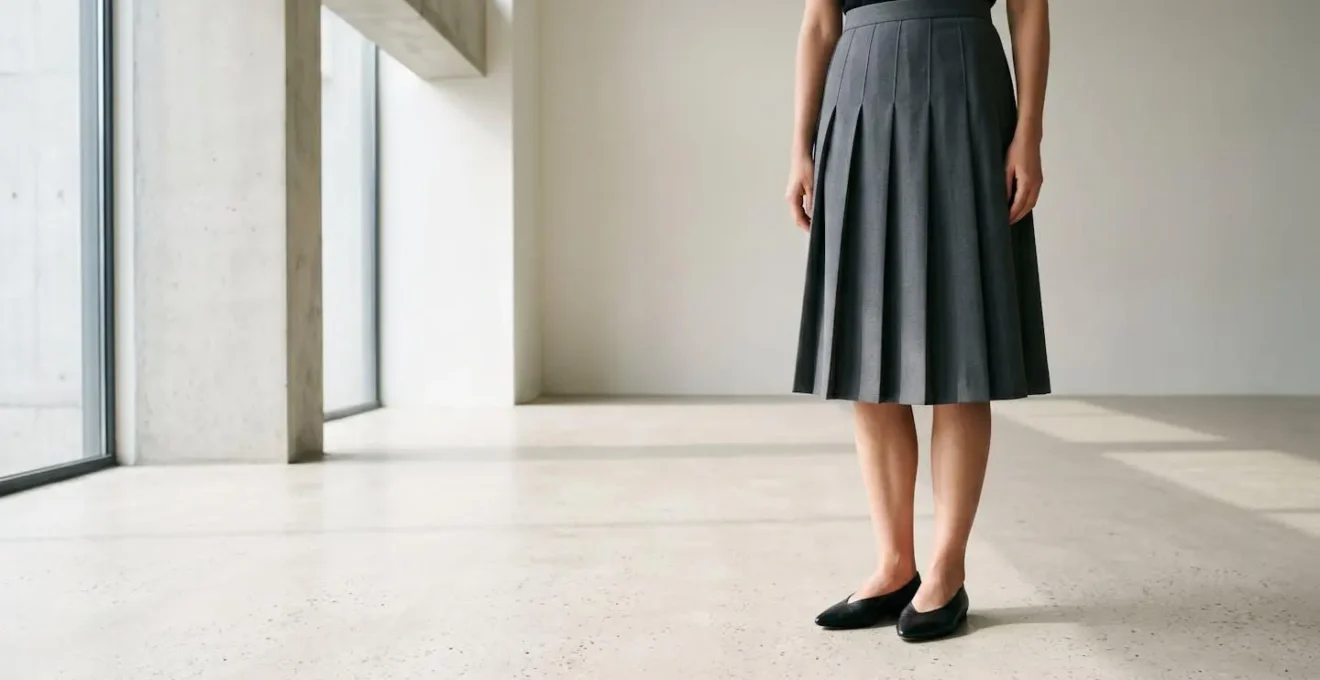
This principle of the line of sight is paramount. You want to encourage the eye to travel smoothly up and down the body. A mid-calf hemline acts like a roadblock, stopping that journey abruptly. If you have skirts or dresses that fall into this zone, don’t despair. You can mitigate the effect by wearing shoes in a color that matches your skin tone or your tights, which helps to visually extend the leg line and counteract the harsh horizontal break of the hem.
Your 5-Step Wardrobe Proportion Audit
- Identify Visual Breakpoints: Lay out 3-5 of your most-worn outfits. For each one, identify every horizontal line created by the clothes: waistbands, hemlines of tops, jackets, and bottoms. Are they dividing you 50/50 or closer to the 1/3 to 2/3 ideal?
- Inventory Your Wardrobe Staples: Collect your key pieces (e.g., favorite jeans, a blazer, a go-to skirt). Assess their inherent volume. Is this an oversized piece that adds visual weight, or a fitted piece that streamlines?
- Audit for Proportional Harmony: Mix and match your staples. Pair an oversized top with fitted bottoms. Try a fitted top with A-line trousers. Do these pairings create a more balanced silhouette than your usual combinations?
- Evaluate Silhouette Impact: Stand in front of a mirror. Try a French tuck with a simple t-shirt and jeans. Note how this small change redefines your waist and lengthens your leg line. Does it create a more dynamic shape?
- Create a Tailoring & Styling Plan: Identify any items with problematic hemlines. Can they be tailored? Or can you use footwear strategies (like pointed toes or nude heels) to mitigate the effect? Prioritize one or two changes to implement immediately.
When to transition from bodycon to structured tailoring as you mature?
The idea of « transitioning » from one style to another as you age is often framed as a set of rules: « women over 40 shouldn’t wear X. » This is a dated and disempowering perspective. A more modern, body-positive approach is to see style evolution not as an abandonment of certain clothes, but as an expansion of your styling vocabulary. The move from body-hugging styles like bodycon to structured tailoring is not about a specific age, but about a shift in aesthetic goals—often moving towards an expression of sophistication and power that tailoring provides.
The legendary Coco Chanel famously stated that fashion is about proportions, a sentiment that perfectly captures this idea. It’s a reminder that great style is about the overall composition, not a single garment.
Fashion is architecture; it is a matter of proportions.
– Coco Chanel, Referenced in Fashion Rule of Thirds Analysis
The real question is not *when* to transition, but *how* to integrate. Structured tailoring—blazers, well-cut trousers, crisp shirts—offers a different kind of power. While a bodycon dress celebrates the body’s natural form, a tailored blazer creates a strong shoulder line and a defined waist through construction. The beauty is that these two worlds are not mutually exclusive. The most contemporary and compelling looks often live in the space between them, a concept known as « soft tailoring. »
Soft Tailoring: The Bridge Between Bodycon and Structure
The evolution of personal style should be about ‘Integration, Not Replacement.’ Instead of discarding fitted pieces, modern styling combines them with structured tailoring to create powerful, contemporary looks. This ‘soft tailoring’ approach might involve layering an open, structured blazer over a sleek bodycon dress. Here, the dress still highlights the figure, but the blazer adds a layer of sophistication and a strong shoulder line. Another example is pairing a fitted knit turtleneck with high-waisted, wide-leg tailored trousers. This leverages the best of both worlds: the comfort and form-fitting nature of the knit with the elegant drape and powerful silhouette of the trousers, creating a polished yet comfortable aesthetic that feels entirely current.
Think of it as adding new tools to your toolbox. You don’t throw away the hammer when you buy a power drill. You use each for its specific strengths. The journey of style is about learning to combine a fitted dress’s confidence with a blazer’s authority to create a look that is uniquely, powerfully yours, at any age.
How to balance an oversized blazer with the right footwear?
An oversized blazer is one of the most versatile pieces in a modern wardrobe, but its final message is almost entirely dictated by your choice of footwear. The blazer itself provides the volume and structure, but the shoes anchor the look and define its context. This is where you can truly play with style archetypes, transforming the same blazer from boardroom-ready to weekend-cool with a simple swap. Understanding this interplay is key to unlocking the full potential of your tailoring.
The principle at play is, once again, balance and intention. The shoes complete the line of sight that starts at the shoulder of the blazer and travels down to the floor. A sleek, pointed heel continues that line, creating an elongated, powerful silhouette. A chunky sneaker, on the other hand, provides a heavy, grounded anchor that contrasts with the blazer’s formality, creating an effortless, « model-off-duty » vibe. Neither is right or wrong; they just communicate completely different things. The wrong pairing happens when the message is muddled—for example, a very formal, double-breasted blazer with delicate, strappy sandals might feel disconnected.
Choosing your footwear is like choosing the punctuation at the end of your outfit’s sentence. It clarifies the tone and completes the thought. The following matrix illustrates how different shoe choices can redefine the message of an oversized blazer, turning it into a tool for various style archetypes.
| Footwear Choice | Style Archetype | Best Blazer Type | Overall Vibe | Ideal Occasion |
|---|---|---|---|---|
| Sleek Heels | Boardroom Power | Single or double-breasted structured | Professional, polished, authoritative | Business meetings, formal events |
| Chunky Sneakers | Model-Off-Duty | Single-breasted worn open | Effortless cool, urban casual | Weekend outings, casual social |
| Loafers | Modern Preppy | Fitted blazer with clean lines | Smart casual, refined yet relaxed | Brunch, creative workplace |
| Combat Boots | Refined Grunge | Oversized single-breasted | Edgy, rebellious, fashion-forward | Concerts, street style events |
By thinking of your shoes as a strategic partner to your blazer, you can multiply the utility of this single garment exponentially. It’s a testament to the idea that true style lies not in the individual pieces, but in the conversation between them.
Key Takeaways
- Stop trying to fit your body into a « shape » category and start mastering the universal principles of proportion and balance.
- The Rule of Thirds is your most powerful tool: avoid 50/50 splits and aim for a 1/3 to 2/3 visual division to elongate your silhouette.
- Every styling choice is about managing visual weight—balance oversized pieces with fitted ones and pay close attention to where your hemlines fall.
Why the « French Tuck » changes the silhouette of a simple look?
The « French Tuck, » popularized by stylist Tan France, is more than just a casual way to half-tuck your shirt. It is a brilliant, low-effort styling technique that masterfully applies the Rule of Thirds and the principle of asymmetry to instantly elevate a simple look. With a basic T-shirt and jeans, a full tuck can feel too formal or severe, while leaving the shirt completely untucked can look shapeless and hide the waist. The French Tuck offers the perfect, strategic middle ground.
By tucking in just the front-center portion of the shirt, you accomplish several things at once. First, you create an instant waistline, even if the shirt is oversized. This small action signals where your waist is, breaking up the torso and preventing a boxy look. Second, you create diagonal lines. The fabric draping down from the tuck on either side draws the eye inward and upward, which is far more dynamic than a straight, horizontal line. This subtle detail makes a look feel more considered and effortless, as The Curvy Fashionista’s editorial team notes.
The front tuck is not lazy. It’s strategic. By tucking just enough fabric to create a break at the waist, you introduce asymmetry and proportion without committing to a full tuck.
– The Curvy Fashionista Editorial Team, The Rule of Thirds in Fashion: A Proportion Trick Plus Size Style Swears By
This technique is a perfect example of how small adjustments can have a massive impact on your overall silhouette. It’s a tool that works on every body type because it’s not about changing your shape, but about defining it. There are several variations of the tuck, each serving a slightly different purpose.
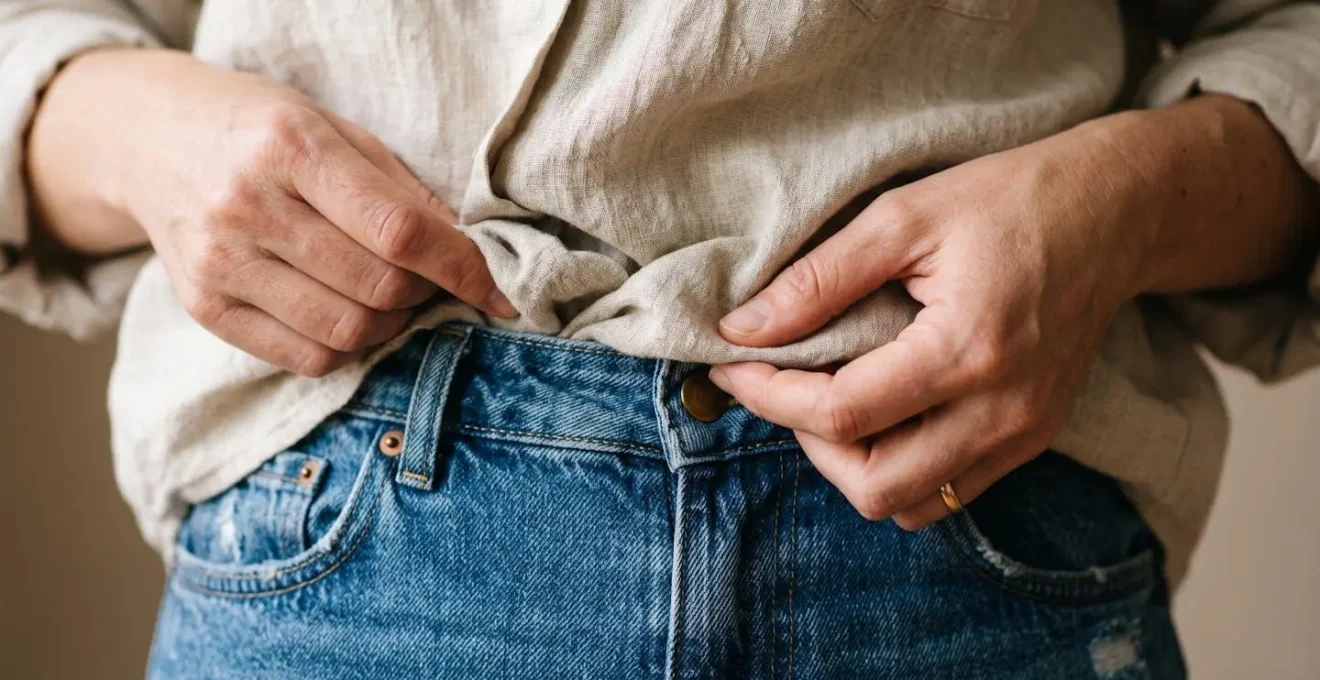
The power of the tuck lies in its ability to introduce proportional harmony with minimal effort. It’s the secret to looking polished and put-together without looking like you tried too hard. Experimenting with these different tucks can unlock new life in tops and bottoms you already own.
What Shoes Should You Wear With Wide-Leg Trousers to Avoid Dragging Hems?
Wide-leg trousers are a statement of relaxed elegance, but they come with a significant proportional challenge: the hem. A hem that is too long will drag on the ground, looking sloppy and quickly becoming damaged. A hem that is too short completely defeats the purpose of the elongating silhouette. The perfect length for a wide-leg trouser is for the hem to « graze » or « kiss » the top of your foot, falling just a fraction of an inch off the floor. Achieving this perfect length is almost entirely dependent on your choice of footwear.
This means you must decide which shoes you will wear with a specific pair of wide-leg trousers *before* you have them tailored. The same trousers cannot be worn with both flat sneakers and high heels without compromising the hemline. For a clean, leg-lengthening effect, a shoe with some height is often ideal. This can be a traditional heel, a block heel, a wedge, or a platform. The added height lifts the hem off the ground while allowing the long, uninterrupted line of the trouser to flow from hip to floor. Pointed-toe shoes are particularly effective, as they extend the visual line of the leg even further. As styling experts advise, the ideal is for just the tip of the shoe to peek out, creating a seamless vertical axis.
But what if you’ve already bought the trousers and they’re too long for your favorite flats? You’re not lost. There are several no-sew solutions you can use for a quick fix.
- Fashion Tape: Use double-sided fashion tape to create a clean, temporary hem on the inside of the trouser leg. This is a secure fix that will last all day.
- The ‘Roll and Pin’ Trick: For a quick adjustment, roll the excess fabric inward and use small safety pins hidden along the inner seam to secure the new length.
- Strategic Platforms: The easiest fix of all is to opt for platform or flatform sneakers. They provide an instant height boost of 1-2 inches, saving your hems without the discomfort of a traditional heel.
Mastering the wide-leg trouser is a masterclass in the partnership between garment and shoe. By committing to a shoe height for each pair, you ensure the architectural integrity of the silhouette remains intact, giving you that coveted, effortlessly chic look.
Start applying these architectural principles today. Instead of asking « Does this trend work for my body type? », ask « How can I make this trend work for my proportions? ». This simple shift in perspective will transform the way you see your wardrobe and, more importantly, the way you see yourself.