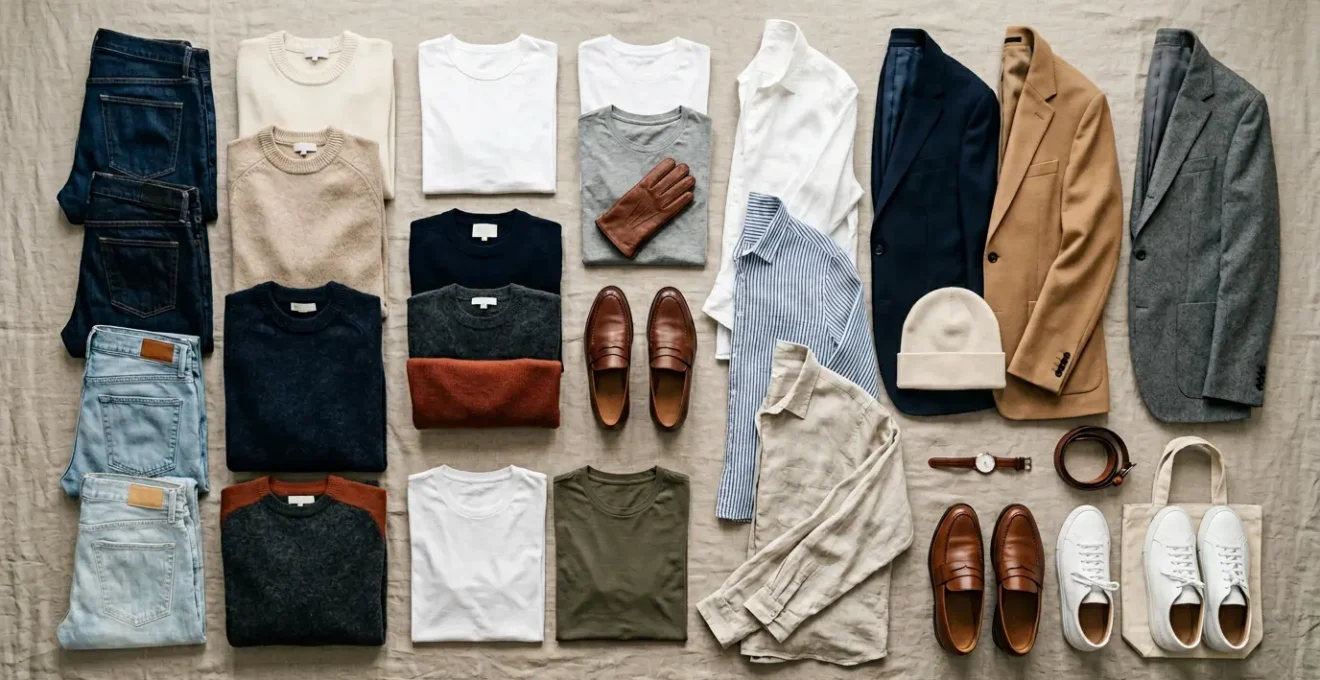
Successfully completing a 33-item wardrobe challenge isn’t about having the perfect clothes; it’s about mastering the mental game against boredom and social anxiety.
- Scientific concepts like the ‘Spotlight Effect’ prove people notice your repeat outfits far less than you think.
- Strategic color formulas (3 neutrals, 2 accents) drastically cut down daily decision fatigue.
Recommendation: Focus on reducing logistical friction (like laundry) and using tools to spark combinatorial creativity with the items you already have.
So, you’ve taken the plunge. You’ve sifted through your closet, made the tough cuts, and committed to Project 333 or a similar minimalist wardrobe challenge. The first week felt liberating, a breath of fresh air. But now, a few weeks in, a quiet dread is creeping in. The initial thrill is fading, replaced by the daunting reality of three months with the same handful of clothes. You’re not just curating a wardrobe; you’re facing a mental endurance test. The core rules—33 items including clothing, accessories, jewelry, and shoes for 3 months—are simple on paper, but the psychological hurdles are the real challenge. You’ve stored the rest of your clothes away, and now it’s just you and this curated collection.
Many guides focus on the initial selection process: pick versatile neutrals, choose quality over quantity. While essential, this advice barely scratches the surface of the day-to-day battle. The real struggle isn’t about what to pick; it’s about staving off outfit fatigue, navigating the logistics of a tiny clothing rotation, and overcoming the irrational fear of being judged for wearing the same shirt twice. You’re questioning if this whole experiment is sustainable or just a fast track to sartorial boredom. Is it even possible to feel creative and confident when your options are so drastically limited?
But what if the key to survival isn’t in the clothes themselves, but in how you frame the entire experience? This isn’t a challenge of limitation; it’s an experiment in creativity and efficiency. The secret lies in treating your small wardrobe as a laboratory. It’s about leveraging psychological hacks to conquer social anxiety, adopting strategic systems to eliminate friction, and discovering the surprising freedom that comes from true constraints. This guide is your survival manual for the middle stretch of the challenge, designed to help you reframe the problems, run the experiments, and emerge not just having survived, but having mastered the art of living with less.
This article will guide you through the common friction points and mental blocks of a minimalist wardrobe challenge, providing you with the strategies to turn them into your greatest strengths. From the practical science of laundry to the psychology of repeating outfits, you’ll find everything you need to reignite your motivation.
Summary: Your Experimental Guide to Mastering a 33-Item Wardrobe
- How often do you really need to do laundry with a small wardrobe?
- Why having fewer clothes makes packing for a trip take 10 minutes?
- Accessories vs. Layers: Which cures the boredom of wearing the same pants?
- The workplace fear of being seen in the same shirt twice in a week
- When to swap your 33 items: Seasonal triggers
- Why choosing 3 neutrals and 2 accents makes getting dressed faster?
- Why using a wardrobe app helps you see combos you never thought of?
- How to Create 30 Different Outfits From Just 10 Pieces of Clothing?
How often do you really need to do laundry with a small wardrobe?
The most immediate point of wardrobe friction in a 33-item challenge is laundry. The fear is a constant cycle of washing, drying, and folding. But this is your first opportunity to reframe the problem. Instead of seeing it as a chore you must do more often, see it as a system you can optimize. The goal isn’t just to have clean clothes; it’s to reduce the frequency of laundry altogether, which benefits both your schedule and the environment. Extending the life of your garments is a core tenet of minimalism, and that starts with washing them less.
The impact is significant. Consciously extending the active life of your clothes by just nine months can lead to a 20-30% reduction in carbon, water, and waste footprints. This transforms laundry from a burden into a powerful act of sustainability. The experiment here is to shift your mindset from « Is it dirty? » to « Does it actually need washing? » Often, airing a garment out or spot-cleaning a small stain is more than sufficient, especially for items not worn directly against the skin.
Your choice of fabric is your greatest lever. A 2020 international study revealed that materials like wool and technical fabrics require far less frequent washing than cotton or synthetics. Wool is naturally antimicrobial and odor-resistant, meaning a wool sweater can often be worn multiple times before needing a wash. By strategically including such low-maintenance fabrics in your 33 items, you are actively engineering a wardrobe that demands less of your time and resources. This isn’t about deprivation; it’s about intelligent design.
Why having fewer clothes makes packing for a trip take 10 minutes?
Here is where your minimalist experiment pays its first huge dividend. Remember the agony of packing? The « what if » scenarios leading to an overstuffed suitcase full of items you never touch? That’s a problem of too much choice, not too little. With a capsule wardrobe, you’ve already done the hard work. Every item in your 33-piece collection is versatile, beloved, and coordinates with almost everything else. Packing is no longer a strategic puzzle; it’s a simple act of gathering.
The mental load of deciding what to bring evaporates. Because your wardrobe is a pre-approved system, you can trust that any combination will work. You can apply simple formulas, like the well-known 5-4-3-2-1 method (5 tops, 4 bottoms, 3 layers, 2 pairs of shoes, 1 accessory), but frankly, you barely need it. You can grab a few tops, a couple of bottoms, and a layering piece, and know with absolute certainty that you have a trip’s worth of cohesive outfits. This process shifts from an hour of stressful deliberation to a 10-minute, almost automatic task.
This efficiency is one of the most tangible rewards of your commitment. The suitcase becomes a perfect, small-scale representation of your entire wardrobe: intentional, clutter-free, and highly effective. There is no more second-guessing, no more « just in case » items. There is only the calm confidence of knowing you have exactly what you need.
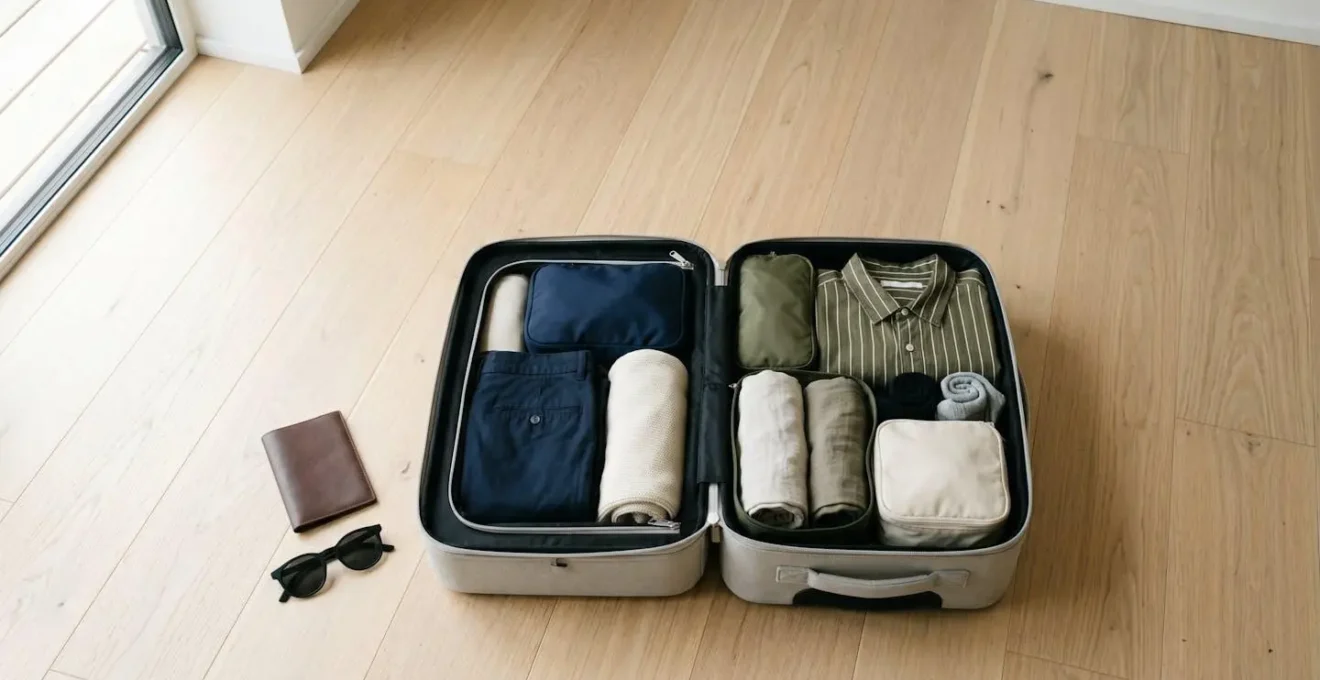
As you can see, the result is not a suitcase of limitations, but one of pure potential. Every piece is a workhorse, ready to be combined in multiple ways. This is the visual proof that less choice can lead to more freedom and dramatically less stress before a trip. Your capsule wardrobe isn’t just for home; it’s your passport to effortless travel.
Accessories vs. Layers: Which cures the boredom of wearing the same pants?
After a few weeks, even the most beloved pair of black trousers can start to feel like a uniform. This is « outfit fatigue, » the primary emotional enemy of any capsule wardrobe challenge. The cure isn’t to buy more clothes; it’s to get strategic with the two most powerful tools in your arsenal: accessories and layers. They serve fundamentally different purposes in the fight against monotony, and understanding when to deploy each is key.
Think of layers as the tool for changing your silhouette. A cardigan, a blazer, or a denim jacket doesn’t just add warmth; it completely alters the shape and feel of an outfit. Tossing a blazer over a simple t-shirt and jeans instantly elevates the look from casual to smart-casual. A long, open cardigan can create a flowing, relaxed vibe. Layers are your architectural tools, allowing you to rebuild the same base into different structures. They are the most effective way to make an outfit feel genuinely different and adapt it to various contexts.
Accessories, on the other hand, are for changing the focal point and mood. They are your stylistic fine-tuners. A statement necklace, a colorful scarf, or a unique belt can draw the eye and inject personality without altering the outfit’s core structure. If you’re wearing the same neutral top and bottom, a vibrant scarf makes the outfit about the scarf, not the base. A bold pair of earrings can shift the focus to your face. Accessories are the fastest and lowest-effort way to add a splash of novelty and prevent a look from feeling stale. So, which is better? It’s not a competition. Layers are for transformation; accessories are for punctuation. Use layers when you need a significant change in formality or function, and use accessories for a quick, daily injection of freshness.
The workplace fear of being seen in the same shirt twice in a week
This is perhaps the biggest psychological hurdle of all: the fear of judgment. In our minds, our colleagues are meticulously tracking our outfits, ready to gossip the moment we repeat a shirt. This anxiety can be so powerful it makes you want to abandon the entire project. But here’s the liberating truth, backed by science: nobody is paying as much attention as you think they are. This cognitive bias is so common it has a name: the Spotlight Effect.
The Spotlight Effect is our tendency to feel as though we are « on stage, » and that our actions and appearance are under constant scrutiny by others. We are the center of our own universe, so we assume we are also at the center of everyone else’s. The reality is far more comforting. Research on this phenomenon is definitive; a landmark study by Cornell University found that people overestimate by 50% how much others notice their appearance. That embarrassing t-shirt you wore? The observers in the study noticed it half as often as the wearer predicted.
Understanding this is a superpower. The fear you feel is a cognitive illusion. Your boss is worried about their own deadlines, and your coworkers are thinking about what to have for lunch. Your blue button-down shirt, worn on Monday and again on Thursday, is a complete non-event in their world. The experiment here is to actively challenge this fear. Wear the same pants twice in a three-day period. Wear the same blazer on Tuesday and Friday. Pay attention. You’ll notice that the world doesn’t end. No one comments. No one even seems to register it. Internalizing this truth frees you from a huge source of anxiety and allows you to fully embrace the benefits of your minimal wardrobe.
When to swap your 33 items: Seasonal triggers
A three-month challenge will almost certainly span a change in weather. This brings up a critical logistical question: when and how do you execute the « seasonal pivot »? This isn’t a moment of failure, but a planned, strategic part of the process. Project 333 allows for this; it’s a rotation, not a permanent vow. The key is to make the swap intentional and analytical, not a chaotic free-for-all where old habits creep back in.
The primary trigger is functional. When you find yourself consistently too hot or too cold in your current items, it’s time to swap. Don’t wait until you’re miserable. If the morning chill requires a heavy coat that isn’t in your 33 items for three days in a row, that’s your signal. The goal is for your wardrobe to serve you, not for you to suffer for your wardrobe. The swap should be a deliberate, one-time event. Box up the outgoing season’s items and bring out the box of potential replacements.
However, this is also a crucial moment for reflection and optimization. Before you simply swap a tank top for a sweater, you must perform an audit of the season that just passed. This is how you refine your capsule for the future, making each 3-month cycle more effective than the last. Use this moment to analyze what worked, what didn’t, and what was missing. This turns the simple act of changing clothes into a powerful data-gathering exercise for your ongoing minimalist journey.
Your Post-Season Wardrobe Audit Plan
- Evaluate each piece: Go through the 33 items from the past season. Did you wear it at least 3 times? If not, question why and whether it deserves a spot next year.
- Assess fit and comfort: Be honest. Does it still fit you perfectly and feel good to wear? A minimalist wardrobe has no room for items that are just « okay. »
- Check for wear and tear: High-frequency wear tests your clothes. Is an item still in good condition, or does it need repair or replacement?
- Identify gaps: What was consistently missing? Did you constantly wish you had a waterproof jacket or a dressier pair of shoes? Note these gaps.
- Plan improvements: Based on your audit, decide what changes you’ll make for the next rotation and for this same season next year. This is how you evolve.
Why choosing 3 neutrals and 2 accents makes getting dressed faster?
The promise of a minimalist wardrobe is less time spent deciding what to wear. But why does this work so well? The answer lies in the psychology of « decision fatigue. » Every choice we make, from what to eat for breakfast to which email to answer first, depletes a finite store of mental energy. With some research showing we make over 35,000 decisions per day, your brain is already overworked. Choosing an outfit from a chaotic closet is one more complex decision draining your reserves before you’ve even left the house.
A capsule wardrobe hacks this system by pre-making most of the decisions for you. By adopting a simple color formula, like the classic 3 neutrals and 2 accent colors, you create a system where almost every item is compatible. Your neutrals (like black, white, navy, or beige) form the versatile base of your wardrobe, while your accent colors (like a specific shade of green or rust) provide the personality. This isn’t a rule of limitation; it’s a framework for guaranteed success.
When you open your closet, you are no longer faced with a sea of conflicting colors and styles. You are looking at a curated palette where any top you grab will almost certainly work with any bottom. The cognitive load plummets. Getting dressed shifts from a creative problem-solving task to a simple matching exercise. You are conserving precious mental energy for the more important decisions that lie ahead in your day.
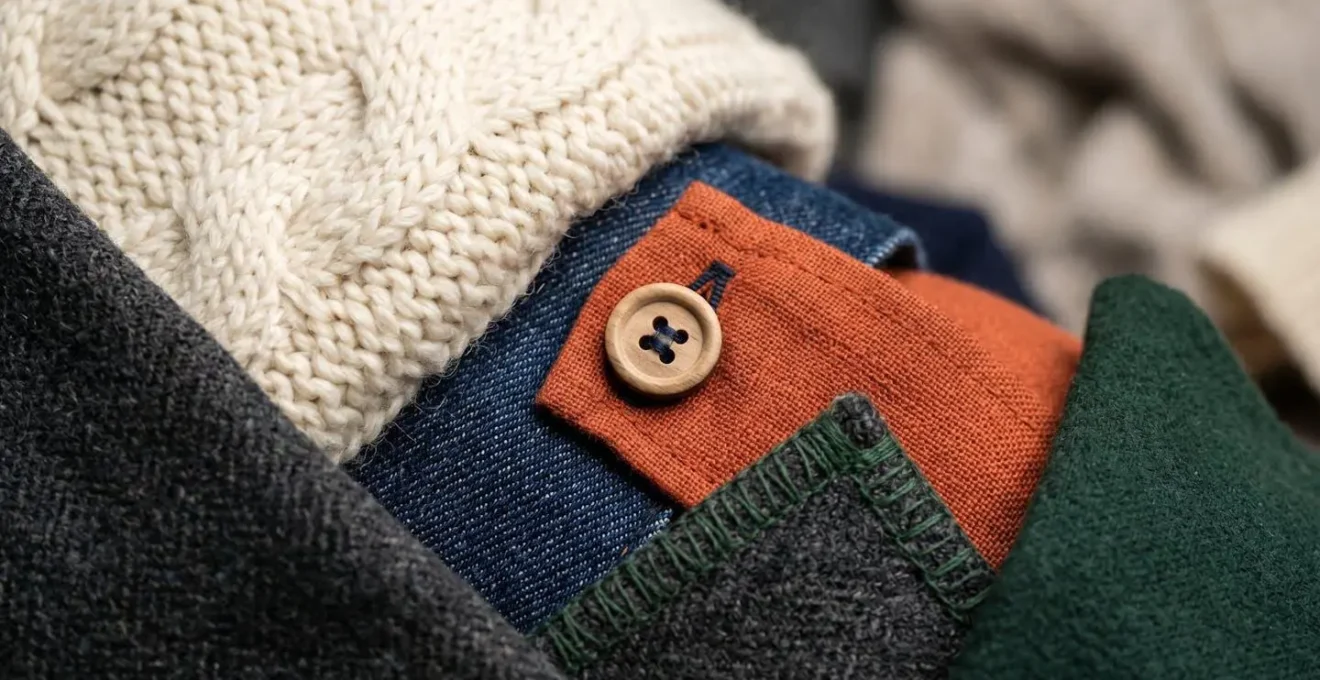
This visual system is the engine of your morning efficiency. The interplay between the reliable neutrals and the exciting accents provides both stability and variety. You are not just picking clothes; you are operating within a high-efficiency system that you designed yourself. This is the ultimate weapon against decision fatigue.
Why using a wardrobe app helps you see combos you never thought of?
Even with the most versatile pieces, our brains fall into ruts. We find a few « safe » combinations and stick to them, quickly leading back to the dreaded outfit fatigue. We become blind to the potential hanging right in front of us. This is where technology can be a surprisingly powerful ally in your minimalist experiment. Digital wardrobe apps are designed to break these mental patterns and unlock what can be called combinatorial creativity.
By digitizing your 33 items—uploading a photo of each one—you give an algorithm the raw data to work with. The app can then shuffle and present combinations you would never have considered. It doesn’t have your preconceived notions or style habits. It sees a blue shirt and patterned skirt and suggests them together, a pairing your brain might have dismissed. It acts as an objective, creative partner, showing you the full mathematical potential of your small collection.
This process can feel like magic, revealing dozens of « new » outfits without you having to buy a single thing. It’s a tool for seeing your own clothes with fresh eyes. Many platforms are even incorporating AI to act as a personal stylist, learning your preferences while still pushing your boundaries.
Platforms like OpenWardrobe use AI personal stylists to suggest outfits from the clothes you already own. It’s like having a stylist on call—without the billable hours.
– OpenWardrobe Blog Editorial Team, Beat Decision Fatigue with Outfit Formulas & Style Blueprint
Using an app is your experiment in augmenting creativity. You provide the curated items, and the technology provides the endless inspiration. It’s a modern solution to the age-old problem of feeling like you have « nothing to wear, » proving that the issue is rarely a lack of clothes, but a lack of vision.
Key Takeaways
- The biggest challenges of a capsule wardrobe (boredom, social fear) are psychological, not practical.
- Scientific concepts like the Spotlight Effect and Decision Fatigue explain why minimalism feels both hard and liberating.
- Strategic systems—for color, laundry, and packing—are the keys to reducing daily friction and succeeding long-term.
How to Create 30 Different Outfits From Just 10 Pieces of Clothing?
The feeling of limitation in a capsule wardrobe is an illusion of perception, not mathematics. Your brain sees 10 or 33 items and thinks « few. » But the power of a capsule isn’t in the number of items; it’s in the number of combinations they can create. The potential is exponentially larger than you imagine. For a full Project 333 wardrobe, mathematical analysis reveals that you could create over 25,176 different outfit combinations. Suddenly, 33 items doesn’t sound so limiting.
Even on a smaller scale, with just 10 well-chosen pieces (e.g., 3 bottoms, 4 tops, 2 layers, 1 dress), you can easily generate a month’s worth of unique looks. The formula is simple: every top must work with every bottom. Each layer must work over every top. This interoperability is what unlocks the combinatorial explosion. Your 10 pieces aren’t 10 outfits; they are the building blocks for dozens.
This principle of scaling your wardrobe based on need is crucial. A weekend trip requires a different capsule size than a month-long journey, but the logic remains the same. It’s about maximizing versatility within a small footprint, with laundry strategy being a key variable.
| Trip Duration | Recommended Pieces | Key Strategy | Laundry Frequency |
|---|---|---|---|
| Weekend (2-3 days) | 9-12 pieces | 3×3 grid formula (3 tops, 3 bottoms, 3 layers) | None needed |
| One Week | 10-12 pieces | Rewear items, sink wash 1-2 pieces | Mid-week refresh |
| Two Weeks | 12-15 pieces | Mix-and-match with strategic layering | After 7 days |
| One Month+ | 15-20 pieces | Seasonal capsule with planned laundry | Weekly routine |
This data-driven approach demystifies the process. Your wardrobe becomes a flexible, scalable system tailored to your specific needs. It’s not about a rigid number; it’s about understanding the powerful relationship between item count, versatility, and time.
Surviving a 33-item challenge is a transformative journey that tests your creativity, discipline, and perception. By reframing the obstacles as experiments and arming yourself with these strategies, you’re ready to not just complete the challenge, but to build a more intentional and effortless relationship with your clothes for the long haul.