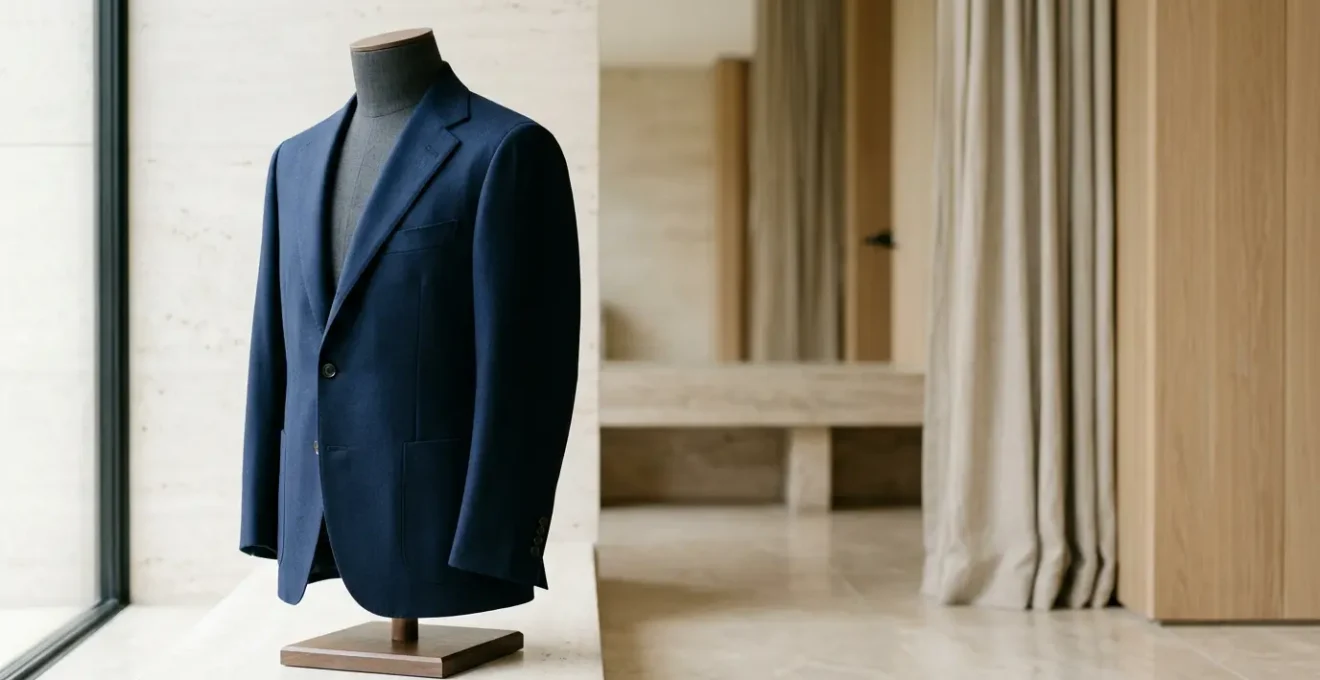
A $300 blazer’s value is proven not by its price tag, but by a measurable Cost-Per-Wear formula that positions it as a high-performing financial asset in your wardrobe.
- Superior construction (canvassed) provides structural integrity that outlasts cheaper, fused alternatives, drastically lowering long-term cost.
- Its true return on investment (ROI) lies in its ability to multiply outfit combinations and retain significant resale value, unlike fast-fashion equivalents.
Recommendation: Evaluate any blazer as a financial asset. Focus your analysis on its construction, fit diagnostics, and fabric performance before making a purchase decision.
The sticker shock is real. In a world of $50 fast-fashion finds, dropping $300 on a single blazer can feel like an unjustifiable luxury. For the savvy builder of a minimalist, capsule wardrobe, every dollar must be accounted for. The common advice to simply « invest in quality » is a platitude that offers no real analytical framework. This approach often ignores the core question of the budget-conscious consumer: what, precisely, am I getting for six times the price, and is the return on investment quantifiable?
Most discussions revolve around vague notions of « better fabric » or « timeless style. » But this perspective fails to treat the purchase with the financial seriousness it deserves. A high-quality blazer is not merely an article of clothing; it’s a hard-working asset. Its value shouldn’t be measured by the initial cash outlay, but by its Cost-Per-Wear (CPW), its potential as a styling multiplier, and even its liquidation value on the resale market. This is a balance sheet calculation, not a retail indulgence.
The true key to determining worth is to move beyond the fashion blog and adopt the mindset of a cost-per-wear analyst. It’s about understanding the hidden mechanics of garment engineering—the difference between a fused and a canvassed jacket, the financial liability of a poor shoulder fit, and the performance characteristics of different wool weaves. Forget fleeting trends; we are building a portfolio of assets designed for maximum performance and longevity.
This analysis will deconstruct the $300 blazer, moving from its internal construction to its external market value. We will equip you with the diagnostic tools to assess structural integrity, identify financial red flags in fitting, and ultimately build an undeniable case for—or against—this cornerstone investment for your capsule wardrobe.
This guide provides a complete analytical framework, breaking down the tangible factors that determine a blazer’s true long-term value. Below, we’ll explore everything from internal construction to fit diagnostics and resale potential.
Summary: The Definitive Guide to Blazer Investment Analysis
- Why fused lining bubbles after dry cleaning unlike canvas construction?
- How to style one navy blazer for a client meeting and a weekend brunch?
- Wool Hopsack vs. Tropical Wool: Which blazer works year-round?
- The « X-crease » warning sign that your blazer is too tight
- 3 hacks to shorten blazer sleeves without a tailor
- Why designer trenches hold 60% value while high street ones hold 0%?
- Why the shoulder seam determines if oversized looks expensive or borrowed?
- What Are the 5 Pillars of a Wardrobe That survives Every Trend Cycle?
Why fused lining bubbles after dry cleaning unlike canvas construction?
The single greatest determinant of a blazer’s lifespan—and thus its long-term Cost-Per-Wear—is its internal construction. Most fast-fashion and lower-priced blazers use a fused construction. This means a fusible interlining is glued to the outer fabric to give the jacket shape. While cost-effective, this method is highly susceptible to failure. The heat and chemicals from dry cleaning degrade the adhesive over time, causing the dreaded « bubbling » or delamination, where the outer fabric separates from the interlining, permanently ruining the blazer’s drape and appearance.
In contrast, a higher-quality blazer often features a canvassed construction. Here, a layer of canvas (typically made from horsehair and wool) is sewn between the lining and the shell fabric. This « floating » canvas is not glued; it moves with your body, allows the fabric to breathe, and molds to your shape over time, creating a superior fit. This structural integrity is why a canvassed jacket withstands repeated cleanings and decades of wear. According to menswear construction experts, fused jackets are prone to bubbling and delamination with repeated exposure to heat and cleaning, making them a poor long-term investment.
Understanding this difference is the first step in your financial analysis. A fused blazer might have a low initial cost, but with a lifespan of only a few years, its CPW can be significantly higher than a canvassed blazer that lasts for ten years or more. You can identify the construction with a simple physical test.
Actionable Audit: The Pinch Test to Identify Construction Quality
- Grab the blazer fabric between the buttonholes with one finger on each side.
- Pinch gently to feel for layers between the inner lining and the outer fabric.
- If you feel a distinct third layer that feels like it’s « floating » or moving independently, you have likely identified a canvassed construction.
- If the fabric feels like a single, stiff piece with no separation, it is almost certainly a fused construction.
This diagnostic tool empowers you to look past the brand and price tag to assess the actual engineering of the garment—a critical skill for any cost-per-wear analyst.
How to style one navy blazer for a client meeting and a weekend brunch?
The second pillar of a blazer’s ROI is its function as a « styling multiplier. » A truly great blazer justifies its cost by dramatically increasing the number of distinct outfits in your capsule wardrobe, thereby reducing the need for other purchases. The key to unlocking this potential lies not in the blazer itself, but in the strategic rotation of a few core components: tops, accessories, and footwear. A single navy blazer can seamlessly transition from corporate formal to relaxed casual with just a few swaps.
For a client meeting, the blazer commands authority when paired with foundational professional pieces. Think a cream silk shell top, tailored trousers, structured leather tote bag, and pointed-toe flats. The look is clean, powerful, and communicates competence. The blazer acts as the architectural anchor, lending structure to the entire ensemble. Here, every element is chosen to project polish and seriousness of purpose.
To transition this same blazer for a weekend brunch, the goal shifts from authority to approachability. This is where you deconstruct the formality. Swap the silk shell for a classic Breton stripe tee. Trade the trousers for well-fitting denim. The structured tote is replaced by a casual canvas bag, and the flats are exchanged for clean, white leather sneakers. The blazer now functions as a relaxed top layer, adding a touch of intentionality to an otherwise effortless look. The sleeves might be pushed up or cuffed to signal a more casual mood.

This transformation highlights the blazer’s role as a versatile chassis. As demonstrated, the surrounding elements entirely redefine its context. By investing in one high-quality piece, you unlock dozens of potential combinations, which is the very definition of a high-performing wardrobe asset. This versatility is a direct contributor to a lower Cost-Per-Wear, as the blazer does the work of multiple, lesser-quality jackets.
Ultimately, the financial value comes from wearing the piece frequently and in varied contexts, a feat only achievable with a truly versatile design.
Wool Hopsack vs. Tropical Wool: Which blazer works year-round?
Fabric selection is a critical variable in the Cost-Per-Wear equation. A blazer that can only be worn for three months of the year will inherently have a higher CPW than one suitable for all four seasons. For a capsule wardrobe investment, versatility is paramount, and this often comes down to choosing the right type of wool. Two of the most common high-performance options are Wool Hopsack and Tropical Wool (Fresco), each with distinct properties that impact its seasonality and function.
Wool Hopsack is prized for its remarkable versatility. It features a basket-like, open-weave structure that makes it more breathable than standard wool twill, yet it retains enough weight and texture to be worn comfortably through autumn and winter. Its matte, textured finish also lends it a more relaxed character, making it an ideal choice for a sport coat or separate blazer that can be dressed up or down. This year-round functionality makes hopsack a workhorse fabric and a prime candidate for a core capsule piece.
Tropical Wool, often sold under the trade name Fresco, is engineered specifically for heat. It’s made from high-twist yarn woven into an extremely open plain weave, maximizing airflow and making it one of the most breathable fabrics available. While unparalleled in summer, its light and airy nature makes it unsuitable for colder temperatures. Its smoother, slightly sheened finish also gives it a more formal appearance, making it better suited for suits than for casual sport coats. As one menswear expert on Styleforum notes, « Hopsack can be used for year-round wear; I typically reserve Fresco for warmer days. » This insight is crucial for an investment-minded decision.
Hopsack can be used for year-round wear; I typically reserve Fresco for warmer days.
– Styleforum menswear expert, Hopsack vs Fresco fabric comparison discussion
The following table, based on discussions from fabric experts, breaks down the key differences for a direct comparison.
| Characteristic | Wool Hopsack | Tropical Wool (Fresco) |
|---|---|---|
| Weave Structure | Chunky plain weave, open-weave structure | High-twist yarn, more open weave than hopsack |
| Breathability | More breathable than twill, less than tropical wool | Highly breathable, most breathable option |
| Texture & Finish | Matte, textured finish, more casual appearance | Smoother, slightly sheened finish, more formal |
| Wrinkle Resistance | Good for travel, hides wrinkles well due to texture | Excellent wrinkle resistance due to high-twist yarn |
| Drape | Natural drape with visible texture | Clean, smooth drape with minimal texture |
| Best Use | Year-round wear, versatile for suits and sport coats | Warmer weather, suits more than sport coats |
| Seasonality | Year-round versatility | Reserved for warmer days and summer |
For a single blazer investment in a capsule wardrobe, wool hopsack is the superior financial choice due to its year-round versatility, directly leading to a lower and more attractive Cost-Per-Wear.
The « X-crease » warning sign that your blazer is too tight
While some aspects of a blazer’s fit are easily adjustable, others are financial liabilities in disguise. The most prominent and costly warning sign is the « X-crease. » This refers to the distinct ‘X’ shape of fabric pulling and creasing that forms around the top button when the blazer is fastened. It is an undeniable signal that the jacket is too tight across the waist and hips. While it may seem like a minor issue, it indicates a fundamental mismatch between the garment’s cut and your body, leading to constant strain on the button and seams.
Ignoring this red flag is a costly mistake. The continuous tension not only creates an unflattering silhouette but also accelerates wear and tear, increasing the likelihood of a popped button or a split seam. More importantly, it points to a fit that can’t be easily or cheaply fixed. Letting out a blazer at the torso is a limited and often expensive alteration.
However, the X-crease is a secondary concern compared to the primary deal-breaker in blazer fit: the shoulders. An improper shoulder fit is the most difficult and expensive issue to correct. The shoulder seam must sit precisely at the edge of your shoulder bone. If it hangs over, the blazer is too big; if it pulls and sits closer to your neck, it’s too small. According to professional tailoring guides, shoulder alterations can cost as much as the blazer itself and are notoriously complex. A bad shoulder fit renders a blazer virtually unwearable and a poor investment, regardless of its price.
Therefore, a cost-per-wear analyst must adopt a strict triage system when assessing fit. The shoulders are a pass/fail test. If they don’t fit off the rack, walk away. The X-crease is a serious warning, suggesting you should size up or try a different cut. Only minor adjustments like sleeve length or waist suppression should be considered acceptable, planned costs.
A blazer that pulls, strains, or fits improperly in the shoulders will never achieve a low Cost-Per-Wear because it will spend more time in your closet than on your back.
3 hacks to shorten blazer sleeves without a tailor
Achieving the perfect sleeve length—where about a quarter- to a half-inch of shirt cuff is visible—is crucial for a polished look. While tailoring is the gold standard, it adds to the total investment cost. For minor adjustments or for a more casual aesthetic, there are several no-sew hacks that can be used to manage sleeve length effectively. These techniques are particularly useful for blazers with a more relaxed construction.
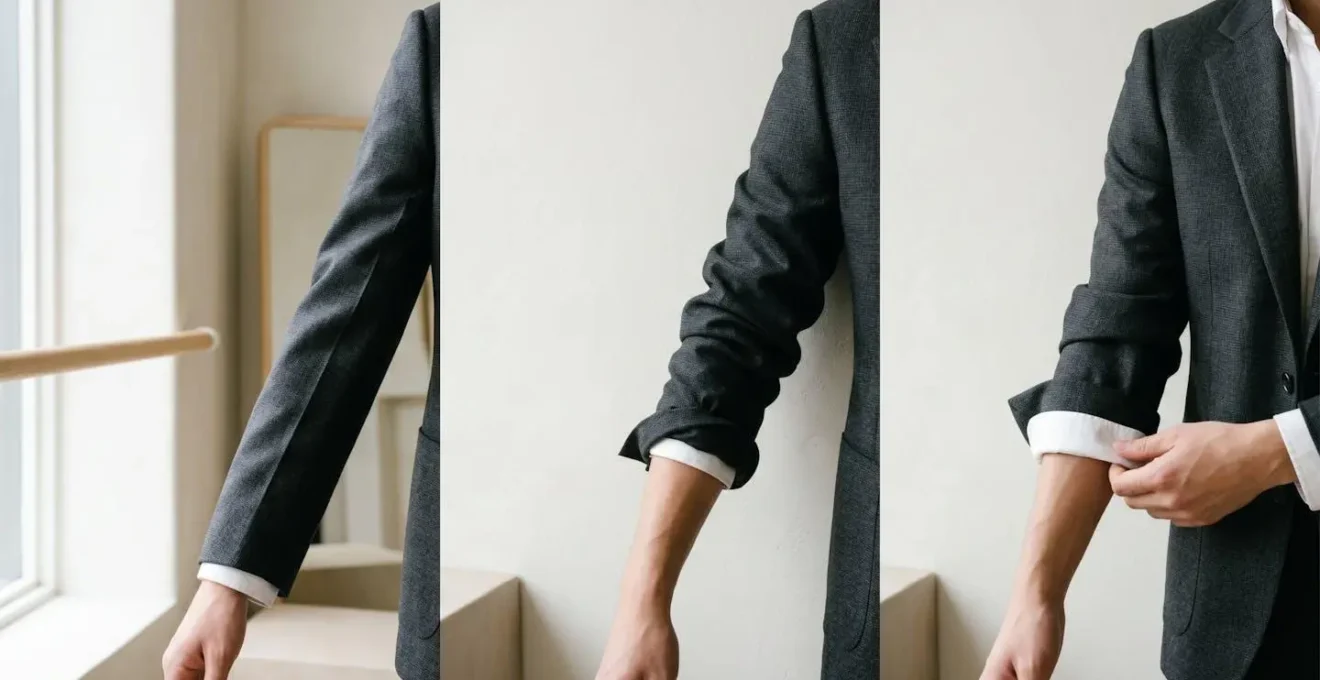
First is the Scrunch-and-Push. This is the most effortless method, ideal for a casual, « undone » look. Simply scrunch the sleeve fabric up your forearm until it sits comfortably just below the elbow. The natural texture of the fabric will often hold it in place. This works best with less structured blazers made from materials like linen or hopsack wool and is perfect for styling with jeans or a casual dress.
Second is the Deep Internal Fold. This technique offers a cleaner look than the scrunch. Lay the blazer flat and fold the sleeve inward from the cuff, tucking the excess fabric up inside the sleeve. The depth of the fold determines the final length. This creates a crisp, cuffless finish that looks intentional and tailored from a distance. It’s an excellent option for maintaining a professional appearance without committing to permanent alterations.
Third is the Master Cuff-and-Roll. This two-step method provides the most secure and stylish non-tailored finish. First, fold the cuff back once to your desired length. Then, grab the bottom of that new fold and roll it up once more, leaving a small sliver of the original cuff’s inner lining exposed. This creates a deliberate, layered look that adds a touch of sartorial flair.
The Surgeon’s Cuff Challenge: When DIY Shortening Is Impossible
A critical factor to identify before attempting any DIY methods is the presence of « surgeon’s cuffs. » Higher-end blazers often feature functional, working buttonholes on the sleeves. This detail is a hallmark of quality but makes alterations significantly more complex and costly, as shortening from the cuff is no longer a simple option. A tailor must instead shorten the sleeve from the shoulder, a far more intricate and expensive procedure. The presence of surgeon’s cuffs serves as a quality indicator but effectively eliminates the possibility of simple DIY sleeve adjustments. Identifying this feature is a key diagnostic step for any potential blazer investment.
These hacks provide flexibility, but recognizing features like surgeon’s cuffs is essential to accurately forecasting the full investment cost of a blazer.
Why designer trenches hold 60% value while high street ones hold 0%?
A crucial, often overlooked, component of the Cost-Per-Wear analysis is the asset’s terminal value. A $300 blazer is not a disposable consumption good like a $50 fast-fashion item; it’s a durable asset with potential for liquidation. The difference in resale value between a well-made garment and a mass-market one is stark. While the H2 title refers to trenches, the principle applies directly to structured blazers: quality retains value, while disposability does not.
High-street or fast-fashion blazers have a resale value that is effectively zero. They are produced with fused construction, lower-quality polyester blends, and are designed to last for a single season. The market for these second-hand items is flooded, and their visible wear-and-tear after a few uses makes them undesirable. Their value depreciates 100% the moment they are purchased.
Conversely, a designer or high-quality blazer from a reputable brand acts more like a long-term asset. Its value is anchored by several factors: superior construction (canvassed), premium materials (like pure wool or silk), timeless design, and brand equity. These pieces are built to last for decades, meaning a second-hand buyer is still acquiring a garment with a significant useful life ahead of it. As a result, they retain a substantial percentage of their original value. A classic blazer from a well-regarded maker can often be resold for 40-60% of its retail price, or even more if it’s a particularly sought-after model.
This dynamic is powered by a robust and growing secondary market. For context, market research confirms that the global luxury resale market was valued at $32.47 billion in 2024 and is projected to surge to over $50 billion by 2030. This thriving ecosystem provides the liquidity that allows you to recover a portion of your initial investment. When you factor in a potential resale value of $150 on a $300 blazer, the net cost of ownership plummets, drastically improving its standing in a CPW calculation against a $50 blazer with a $0 resale value.
Viewing a blazer purchase through this lens—as an asset with a calculable depreciation curve and liquidation value—is the mark of a true cost-per-wear analyst.
Why the shoulder seam determines if oversized looks expensive or borrowed?
The « oversized » trend presents a unique challenge for the investment-minded analyst. When executed correctly, an oversized blazer projects an air of effortless, intentional style. When done wrong, it simply looks like you’re wearing someone else’s clothes—a cheap and unflattering mistake. The single most important element that distinguishes an expensive, deliberate oversized look from a poorly fitting, borrowed one is the shoulder construction and seam placement.
A truly « oversized » designer blazer is not just a standard blazer made in a larger size. It has been specifically engineered with a « drop shoulder. » This means the armhole and shoulder seams are intentionally designed to sit lower down the arm, creating a soft, sloping silhouette. The rest of the jacket is then proportioned to balance this extended shoulder line. It’s a calculated design choice that requires expert pattern-making. This intentionality is what the eye perceives as high-fashion and expensive.
The shoulder seam should sit exactly where your shoulder ends. If the seam hangs over your shoulder, the blazer is too big. If it sits closer to your neck and pulls, it’s too small.
– Professional blazer fit guide, How Should a Blazer Fit a Woman
In contrast, simply buying a standard-cut blazer two sizes too big results in a disastrous fit. The shoulder pads and seams will jut out awkwardly past your natural shoulder, creating a boxy, ill-fitting look. This is where the practical « Divot Test » becomes an invaluable diagnostic tool for telling the difference.
To test if a blazer’s shoulders are too big and creating an unintentional oversized look, try this technique: Put on the jacket and stand with your shoulder facing a wall. Slowly lean toward the wall. If the shoulder pad makes contact with the wall before you do, you’re in ‘divot territory’ — the telltale sign that the blazer is genuinely too large rather than intentionally oversized. This practical test distinguishes between deliberate drop-shoulder design and simply poor fit.
– The Divot Test, Stitch Fix Style Guides
When investing in a blazer, especially if you’re considering an oversized style, you must be able to discern intentional design from a simple sizing error. The former is a style choice that can hold value; the latter is just a bad fit that will have a high Cost-Per-Wear because it looks cheap and will rarely be worn.
Pay for deliberate design and expert tailoring, not for extra, ill-fitting fabric. The shoulder seam is the ultimate arbiter.
Key Takeaways
- A blazer’s true cost is measured by Cost-Per-Wear (CPW), not its initial price.
- Construction is key: Canvassed blazers outlast fused ones, offering better long-term value.
- Fit is a financial indicator: Shoulder fit is non-negotiable, while other issues like an « X-crease » are costly red flags.
- Versatility and resale value are quantifiable metrics that significantly lower the net cost of ownership.
What Are the 5 Pillars of a Wardrobe That survives Every Trend Cycle?
Ultimately, the decision to invest in a $300 blazer transcends a single purchase. It’s about adopting a strategic framework for building a timeless, high-performance wardrobe that survives fleeting trend cycles. This framework rests on five core pillars that ensure every piece is a sound investment, not a sunk cost. By internalizing this philosophy, you can construct a capsule wardrobe where every item, including your blazer, works harder and delivers a measurable return.
As a leading wardrobe strategy guide notes, « A structured blazer is one of the investment pieces that changes outfits immediately, increases outfit combinations, and reduces decision fatigue. » This statement perfectly encapsulates the goal. The pillars below provide the roadmap to acquiring such pieces.
A structured blazer is one of the investment pieces that changes outfits immediately, increases outfit combinations, and reduces decision fatigue.
– The Capsulist wardrobe strategy guide, Best Capsule Wardrobe Brands 2026
Based on insights from capsule wardrobe experts, these are the five pillars for investment-worthy wardrobe construction:
- Pillar 1 – Superior Construction: Prioritize longevity by choosing half-canvas or full-canvas construction over fused. Use diagnostic tools like the « Pinch Test » to verify the floating canvas layers that provide structure, drape, and a decades-long lifespan.
- Pillar 2 – Uncompromising Fit and Tailorability: Master the hierarchy of fit. The shoulder fit is the primary, pass/fail criterion. Differentiate between deal-breaker issues (shoulder width, armhole height) and acceptable, easily tailorable adjustments (sleeve length, waist suppression).
- Pillar 3 – Fabric First Philosophy: Invest in natural fibers with proven performance records. Choose materials like wool hopsack for year-round versatility and tropical wool for superior breathability. Fabric quality dictates not only the feel but how a garment ages and performs over time.
- Pillar 4 – The ROI of Confidence: Move beyond simple CPW calculations to consider the intangible returns. A perfectly fitting, high-quality blazer is a decision-elimination tool. It removes guesswork, multiplies your confidence, and fundamentally alters how you are perceived in personal and professional settings.
- Pillar 5 – Asset Retention & Resale Value: Treat every major purchase as a balance sheet asset. Invest in pieces from brands with proven brand equity and quality that retain value on the robust luxury resale market. This provides a financial backstop and dramatically lowers your net investment.
Applying this five-pillar framework to every potential purchase, especially a cornerstone piece like a structured blazer, is the ultimate way to guarantee your wardrobe is not just stylish, but financially sound and built to last.