
The daily struggle of dressing for fluctuating temperatures isn’t solved by carrying more clothes, but by building a smarter, more systematic wardrobe. The key is to stop thinking in terms of individual garments and start acting like a « layering architect. » This involves selecting pieces based on their specific thermodynamic properties—like fabric breathability, weave structure, and construction—to create a cohesive system that adapts to the day, ensuring you remain comfortable and stylish without the need for a bulky bag.
The morning commute begins with a brisk 10°C chill that demands a proper jacket. By lunchtime, the sun is out, the temperature has climbed to a pleasant 20°C, and that same jacket is now an inconvenient burden. This daily thermal battle is a familiar frustration for anyone living through the transitional seasons of spring and autumn. The common advice is to simply « wear layers, » a vague suggestion that often leads to bulky, mismatched outfits and the dreaded tote bag filled with discarded sweaters and scarves.
This approach treats clothing as a crude on/off switch for warmth. We pile things on in the morning and peel them off in the afternoon. But what if the solution wasn’t about adding and subtracting, but about creating an intelligent, self-regulating system? What if the key to all-day comfort was not in the *quantity* of your layers, but in the architectural logic behind them? This guide moves beyond generic tips to provide a problem-solving framework. It focuses on the science of fabrics, the engineering of garments, and the strategy of styling.
We will deconstruct the essential components of a transitional wardrobe, piece by piece. You will learn why a trench coat is more than just a jacket, how to choose footwear that anticipates the weather, and which fabrics work with your body’s temperature, not against it. By the end, you will have the blueprint to engineer outfits that are not only comfortable from dawn to dusk but also look deliberate, polished, and entirely effortless.
This article provides a structured approach to mastering transitional dressing. Below, the summary outlines the key architectural principles we will explore, from foundational fabric choices to advanced styling techniques.
Summary: The Architect’s Guide to All-Day Comfort
- Why the trench is the ultimate transitional shield against wind?
- Loafers vs. Ankle Boots: Which handles unpredictable rain better?
- Cotton vs. Polyester: Which prevents sweating when the sun comes out?
- The mistake of packing away sweaters too early in April
- 3 types of camisoles that regulate temperature invisibly
- Wool Hopsack vs. Tropical Wool: Which blazer works year-round?
- How to style a trench coat over a hoodie to look intentional?
- What Are the 5 Pillars of a Wardrobe That survives Every Trend Cycle?
Why the trench is the ultimate transitional shield against wind?
A trench coat’s supremacy in transitional weather isn’t about providing heavy insulation; it’s about acting as a high-performance shield. Its primary function is to neutralize the two most unpredictable elements of spring and autumn: wind and light rain. The genius lies in its very fabric. The original design was purpose-built not for warmth, but for protection, a principle that remains its core strength. As historical context shows, the revolutionary gabardine fabric was invented in 1879 by Thomas Burberry specifically to be breathable, waterproof, and durable.
This textile is a tightly woven twill that creates a physical barrier against wind chill, which can make a 10°C morning feel significantly colder. Unlike a heavy wool coat that traps heat (and can become stifling by afternoon), the trench coat’s lightweight structure blocks the wind without causing you to overheat. The illustration below highlights the dense weave and functional details that make it so effective.
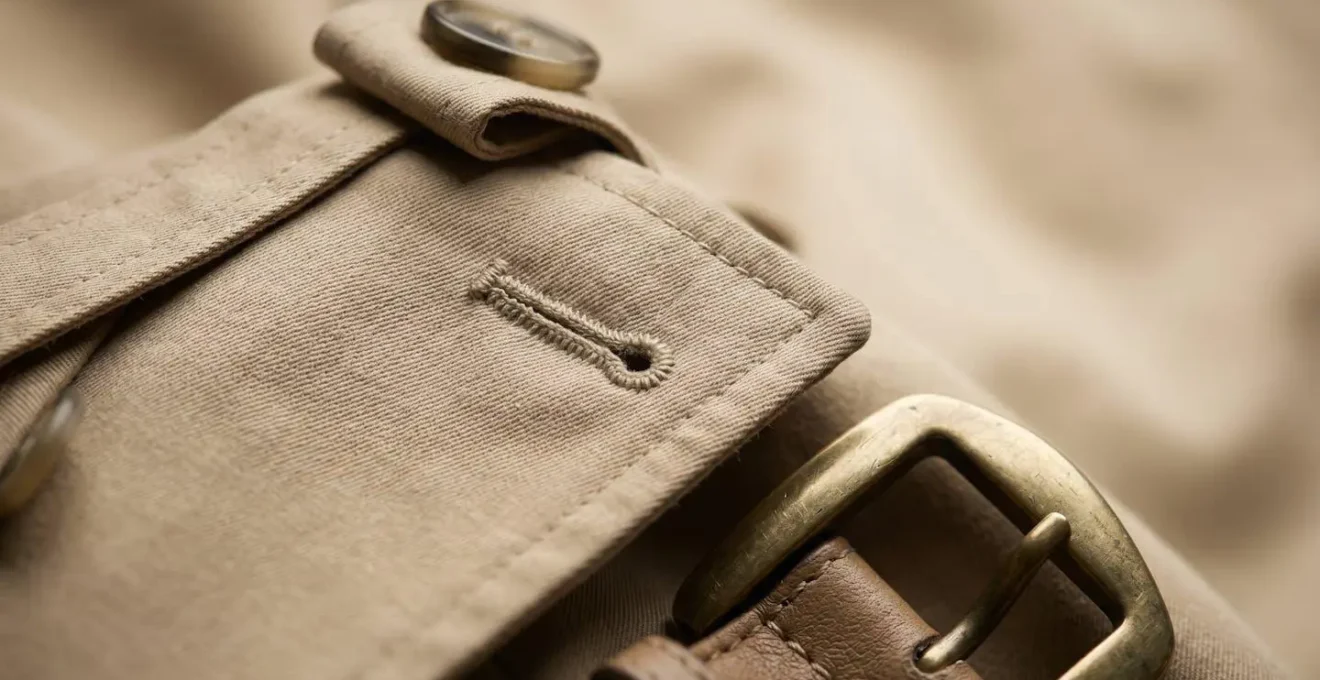
As you can see, the construction is engineered for defense. Details like the storm flap, double-breasted closure, and cuffed sleeves are all designed to seal out the elements. This heritage as a functional garment is its greatest asset. Wikipedia contributors note its intended use perfectly:
The trench coat was typically worn as a windbreaker or as a rain jacket, and not for sole protection from the cold in winter.
– Wikipedia contributors, Trench coat – Wikipedia
Therefore, the trench coat is the perfect outer shell in a layering system. It manages the external environment, allowing you to fine-tune your personal temperature with the layers worn underneath. It is not an insulator; it is a regulator, making it the ultimate architectural piece for a 10°C to 20°C day.
Loafers vs. Ankle Boots: Which handles unpredictable rain better?
When engineering an outfit for a day with a 10-degree temperature swing, footwear is the foundation. The choice between loafers and ankle boots is not merely aesthetic; it’s a strategic decision based on anticipating environmental conditions, especially unpredictable rain. While loafers offer unmatched ease and breathability for a sunny 20°C afternoon, they are structurally vulnerable to moisture. Their low profile and often-stitched soles can quickly let in water, compromising comfort for the rest of the day.
Ankle boots, by contrast, are architecturally superior for handling weather-related uncertainty. Their advantage lies in two areas: coverage and construction. The higher shaft provides a physical barrier against splashes and light rain, keeping your ankles and socks dry. More importantly, well-made boots often feature a construction method specifically designed for water resistance and longevity. This is where investing in quality becomes a functional, not just financial, decision.
Case Study: Goodyear Welt Construction for Durability
Investment boots with Goodyear welt construction are a prime example of functional design. This method involves stitching a strip of leather (the « welt ») to the upper and then stitching that welt to the sole. This creates a robust, layered barrier between the insole and the outsole, significantly inhibiting water from penetrating the shoe from below. Furthermore, this construction allows the boots to be resoled multiple times, drastically extending their lifespan over decades of wear while maintaining their water-resistant properties. It turns the boot from a disposable item into a maintainable part of your wardrobe system.
Therefore, the choice is a risk assessment. On a guaranteed dry day, loafers are an excellent, lightweight option. However, for the typical transitional day where a shower is a possibility, a well-constructed ankle boot is the more resilient and logical choice. It provides a reliable foundation that won’t fail if the weather turns, embodying the core principle of a system built to perform under various conditions.
Cotton vs. Polyester: Which prevents sweating when the sun comes out?
The base layer, the garment worn closest to your skin, is the most critical component for thermal regulation. Its performance dictates whether you feel comfortable or become a sweaty mess when the afternoon sun appears. The choice between natural fibers like cotton and synthetic fibers like polyester is a matter of material science, and the difference in their interaction with moisture is staggering.
Cotton is hydrophilic, meaning it loves water. When you perspire, a cotton T-shirt or camisole acts like a sponge, absorbing the moisture and holding it against your skin. This feels clammy and heavy. Worse, as the temperature drops again or a breeze hits, that trapped moisture makes you feel cold and damp. In contrast, polyester is hydrophobic—it repels water. It does not absorb moisture; instead, it allows sweat to pass through the fabric to the surface, where it can evaporate. This process is known as moisture-wicking.
The scientific data is unequivocal. When measuring how much moisture a fabric can regain from the air, cotton has an 8.5% moisture regain compared to polyester’s 0.4%. This massive difference is what you feel on your skin. The following illustration provides a clear visual of this behavior.
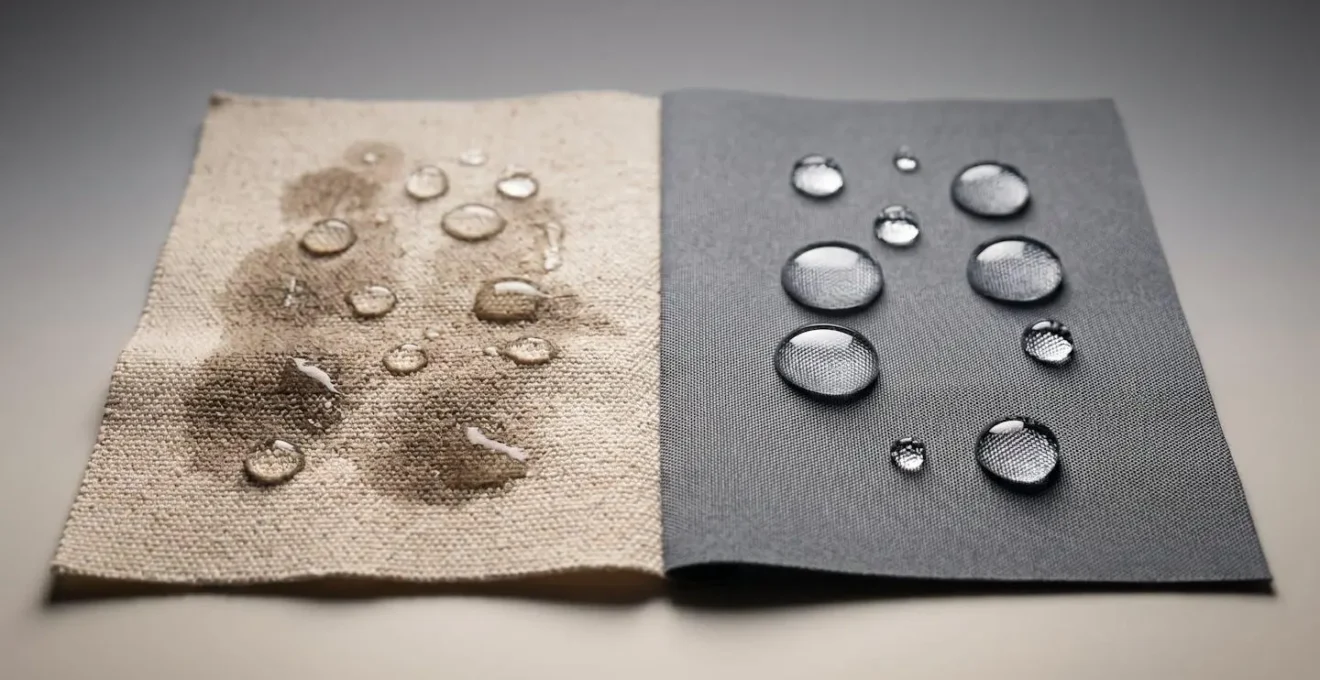
As shown, water beads up on the surface of the synthetic fabric, ready to evaporate, while it soaks into the cotton, darkening the fabric and trapping the moisture. For a day that starts cool and ends warm, this is the crucial factor. A polyester or other synthetic base layer will keep you dry and comfortable when you start to warm up on your commute or as the day progresses. A cotton base layer will betray you the moment you start to sweat, leaving you uncomfortable for hours. From a systems-architecture perspective, a hydrophobic base layer is the only logical choice for managing fluctuating temperatures.
The mistake of packing away sweaters too early in April
A common error in seasonal wardrobe transition is the premature storage of all knitwear. The first hint of a 20°C afternoon leads to a purge, leaving a gap in the wardrobe system precisely when a « transitional sweater » is most needed. This isn’t just any sweater; it’s a specific garment engineered to bridge the 10-degree gap. Its value lies in its material and weight, allowing it to function as a warm layer in the cool morning and a stylish, non-bulky accessory in the warm afternoon.
The mistake is thinking of sweaters as purely winter items. A transitional sweater, often made from materials like lightweight merino, cashmere, or high-quality cotton, provides insulation without the bulk of heavy winter knits. As The Wardrobe Consultant notes, « Make sure your wardrobe has pieces in fabrics like cotton, tencel, or lightweight denim. These are the unsung heroes of transitional dressing. » The right sweater can be worn over a base layer in the morning and then, crucially, be draped over the shoulders or tied around the waist without creating an awkward, bulky silhouette when not needed.
To avoid this mistake, you must evaluate your knitwear with a more critical, architectural eye. Instead of a simple « winter vs. summer » classification, use a framework to identify which pieces have the versatility to serve you during these in-between months. The following checklist provides a systematic method for this evaluation.
Action Plan: Transitional Sweater Evaluation Framework
- Weight Assessment: Evaluate whether the sweater is lightweight enough for 20°C afternoons yet substantial enough for 10°C mornings.
- Drape Test: Check if the sweater can be comfortably worn over shoulders or tied around the waist without adding bulk.
- Wrinkle Resistance: Determine if the knit can be packed, removed, and worn throughout the day without looking disheveled.
- Breathability Check: Test if the fabric allows air circulation during temperature increases while maintaining insulation during cooler periods.
- Versatility Score: Confirm the sweater pairs with both winter holdovers (boots, structured trousers) and spring previews (lighter denim, loafers).
By methodically assessing your sweaters against these criteria, you identify the true workhorses of your transitional wardrobe. This prevents the all-too-common scenario of being caught without an appropriate mid-layer, reaffirming the importance of a well-engineered system over a reactive, seasonal approach.
3 types of camisoles that regulate temperature invisibly
The camisole, or undershirt, is the invisible engine of your layering system. While often overlooked, selecting the right one based on its material properties can dramatically enhance your ability to regulate temperature throughout the day. It is your first line of defense, managing the microclimate right next to your skin. From an architectural perspective, there are three primary types of performance camisoles to consider for a transitional wardrobe.
1. The Silk Camisole: The Frictionless Layer
Silk’s primary advantage is not thermal but mechanical. Its smooth, low-friction surface allows outer layers, like a sweater or blazer, to glide over it effortlessly. This prevents clinging and bunching, preserving a clean and intentional silhouette. While a natural insulator, its main role here is to facilitate elegant layering, ensuring your outfit moves with you, not against you.
2. The Merino Wool Camisole: The Moisture Manager
Merino wool is the undisputed champion of thermoregulation. It is a highly intelligent fiber that actively works to keep you comfortable. As research from North Carolina State University highlights, merino has a unique structure that makes it both hydrophobic (water-repelling) on the outside and hydrophilic (water-absorbing) on the inside. This allows it to manage moisture vapor before it even turns into sweat. In fact, studies demonstrate that merino wool can absorb up to 35% of its weight in moisture without feeling wet to the touch.
Merino wool’s unique dual-layer—hydrophobic outside and hydrophilic inside—absorbs up to one third of its weight in moisture vapour without feeling wet, enabling efficient moisture transport and stabilising next to skin microclimate.
– North Carolina State University Research Team, Merino wool proven to have superior thermoregulation advantage
3. The Technical Synthetic Camisole: The Quick-Dry Workhorse
This category includes modern fibers like Modal, Tencel, and high-performance polyesters. Similar to the discussion in the previous section, their key feature is being hydrophobic and fast-drying. These camisoles are designed to wick moisture away from the skin and disperse it over a larger surface area for rapid evaporation. They are incredibly lightweight and durable, making them an excellent choice for active commutes where you might build up a bit of heat. They provide a reliable, dry foundation that prevents the chill that comes from damp fabric.
Wool Hopsack vs. Tropical Wool: Which blazer works year-round?
A blazer is the ultimate « third piece » in a layering architect’s toolkit. It adds structure, polish, and a moderate layer of insulation. However, not all wool blazers are created equal. The weave of the fabric is the critical variable that determines its breathability and suitability for transitional weather. The two most common options, hopsack and tropical wool, serve very different functions.
Tropical wool is a lightweight, plain-weave fabric made from high-twist yarns. It’s smooth, refined, and drapes beautifully, making it an excellent choice for hot, summery conditions. However, its tight weave offers less natural ventilation. Wool hopsack, on the other hand, is a basketweave fabric. Its construction creates a pattern with tiny, open spaces, resulting in a fabric that is significantly more breathable and airy. This open structure allows air to circulate freely, making it far superior for a day that involves temperature fluctuations. It offers warmth in the cool morning air but won’t trap heat when the afternoon sun hits.
Furthermore, the looser weave of hopsack gives it a natural wrinkle resistance that tropical wool lacks, making it a more practical choice for a commuter who might drape it over a chair or carry it during the warmer part of the day. A direct comparison reveals why hopsack is the superior choice for a versatile, year-round blazer, as detailed in an analysis of wool’s thermoregulation properties.
| Characteristic | Wool Hopsack | Tropical Wool |
|---|---|---|
| Weave Structure | Basketweave creating open airflow spaces | High-twist yarns in plain weave |
| Breathability | Extremely breathable due to weave pattern | Lightweight and airy but less structured ventilation |
| Wrinkle Resistance | Naturally wrinkle-resistant (ideal for travel) | Moderate; requires more care |
| Weight | Medium weight (suitable 3 seasons) | Lighter weight (best for warm weather) |
| Drape Quality | Drier, textured hand; excellent standalone drape | Smoother, softer hand; refined appearance |
| Best Use Case | Transitional layering piece; packable third layer | Summer formal wear; hot climate suiting |
For the layering architect building a system to handle 10°C to 20°C, a wool hopsack blazer is the clear winner. Its combination of breathability, durability, and wrinkle resistance makes it a reliable, high-performance component of a truly transitional wardrobe.
How to style a trench coat over a hoodie to look intentional?
Combining a classic trench coat with a casual hoodie is an advanced layering move. When executed poorly, it can look accidental and sloppy. When done right, it creates a modern, high-low look that is both stylish and perfectly suited for fluctuating temperatures. The key is to make the combination look intentional. This is achieved not by chance, but through a series of deliberate styling rules that control proportion, color, and detail. It’s about signaling that you have architected the look, not just thrown on clothes.
The goal is to bridge the gap between the tailored structure of the trench and the relaxed nature of the hoodie. This requires creating a cohesive visual message. A monochromatic or tonal color palette is the most effective way to do this; a beige trench with a cream hoodie, or a navy trench with a grey hoodie, immediately looks more considered than clashing colors. The silhouette is equally important. A bulky hoodie under a slim-fit trench will look strained and uncomfortable. The architecture must be balanced.
To master this look, follow this five-step blueprint for creating an intentional silhouette:
- Proportion Balance: Pair a relaxed or oversized trench with a well-fitting (not bulky) hoodie. This creates a deliberate contrast in shape without adding excessive volume.
- Color Cohesion: Use monochromatic or tonal palettes (e.g., beige trench with a cream hoodie, navy with grey) to signal that the pairing is a conscious style choice.
- Bridge the Gap: Complete the outfit with sharp trousers or clean, dark-wash denim. Pair with minimalist sneakers or loafers to ground the look and balance the high-fashion (trench) and streetwear (hoodie) elements.
- Hood Management: The most crucial detail. Ensure the hoodie’s hood lays flat and neat over the trench’s collar and lapels. Adjust the drawstrings so they are even and tidy, not dangling randomly.
- Sleeve Reveal: Push up or cuff the trench sleeves slightly to reveal the cuffs of the hoodie underneath. This small gesture is a powerful styling signal that communicates deliberate, thoughtful layering.
By adhering to these principles, you transform a potentially awkward combination into a sophisticated statement. You demonstrate a mastery of layering that goes beyond pure function, proving that a practical outfit for a 10°C-to-20°C day can also be at the forefront of contemporary style.
Key Takeaways
- Transitional dressing is a system, not a collection of items. Focus on how pieces work together.
- Prioritize fabric science: hydrophobic base layers (synthetics, merino) are essential for managing moisture and preventing chills.
- Invest in architectural details: the weave of a blazer (hopsack) and the construction of footwear (Goodyear welt) dictate performance.
What Are the 5 Pillars of a Wardrobe That survives Every Trend Cycle?
The principles of transitional dressing are not just about surviving a single day’s weather; they are the foundation for building a timeless, resilient wardrobe. A system that can handle a 10-degree temperature swing is, by its very nature, a system built on versatility, quality, and function. This is the antidote to the endless cycle of trends. A truly sustainable wardrobe is not one that is static, but one that is adaptable. It is built upon five fundamental pillars that ensure longevity and relevance, season after season.
These pillars shift the focus from « what’s new » to « what works. » They encourage a more architectural approach to your closet, where each piece is selected for its intrinsic qualities and its ability to integrate with the whole. This mindset also has a significant financial benefit; research demonstrates that quality pieces cost less per wear than cheaper, trend-driven alternatives that require frequent replacement. Embracing these five pillars is an investment in both personal style and long-term value.
The 5 Pillars of a Timeless Wardrobe
- Pillar 1: Superior Fabric Science. Prioritizing natural, high-performance fibers like merino wool, cashmere, silk, and high-quality cottons, as well as technologically advanced synthetics where function dictates. Understanding how a fabric breathes, drapes, and handles moisture is the first step.
- Pillar 2: Quality Construction. Focusing on how a garment is made. This includes details like the welt of a shoe, the weave of a blazer, reinforced seams, and quality hardware that ensure durability and a long lifespan.
- Pillar 3: Versatile Silhouettes. Investing in classic, well-proportioned shapes—the straight-leg trouser, the perfect-fit blazer, the timeless trench—that are not tied to a specific era and can be styled in countless ways.
- Pillar 4: A Neutral Foundation. Building the core of your wardrobe around a cohesive palette of neutrals (like black, navy, grey, beige, and white). This ensures maximum interchangeability between pieces, allowing for more outfit combinations from fewer items.
- Pillar 5: A System-Based Approach. Viewing your wardrobe not as a collection of individual items, but as an integrated system. Every new piece should be evaluated on its ability to work with what you already own, solving a problem or filling a specific functional gap.
By building your wardrobe on these five pillars, you create a collection of clothes that not only solves the practical problem of dressing for fluctuating temperatures but also transcends fleeting fashion cycles, serving you reliably and stylishly for years to come.
Building a wardrobe that is both timeless and functional starts with asking the right questions. The next step is to apply this architectural thinking to your own closet, evaluating each piece not just for its style, but for its performance within your personal clothing system.
Frequently Asked Questions About Building a Timeless Wardrobe
How do I identify which pieces are worth investing in versus fast-fashion purchases?
Focus on fabric quality (natural fibers age beautifully), construction details (reinforced seams, quality stitching), and versatility. Ask yourself: ‘Will I wear this at least 30 times?’ and ‘Does this work with multiple existing pieces in my wardrobe?’ Investment pieces should solve problems (warmth, versatility, day-to-night adaptability) rather than follow fleeting trends.
Can investment pieces work for changing body shapes and evolving personal style?
Absolutely. Well-constructed garments in classic silhouettes (straight-leg trousers, unstructured blazers, timeless trenches) adapt to body changes through adjustable elements like belts and tailoring. Focus on pieces with drape and fluidity rather than rigid fits. A quality blazer can serve your wardrobe for decades, adapting to style evolution while maintaining structural integrity.
How should I balance neutral investment pieces with personal color preferences?
While neutrals provide maximum interchangeability, colors do not go out of style—only their prevalence in stores changes seasonally. Invest in both: neutral foundations (trench, tailored trousers, quality denim) and striking colors in pieces you love (cashmere sweaters, silk blouses). Any color that makes you look radiant will always look stylish and on point, regardless of trend cycles.