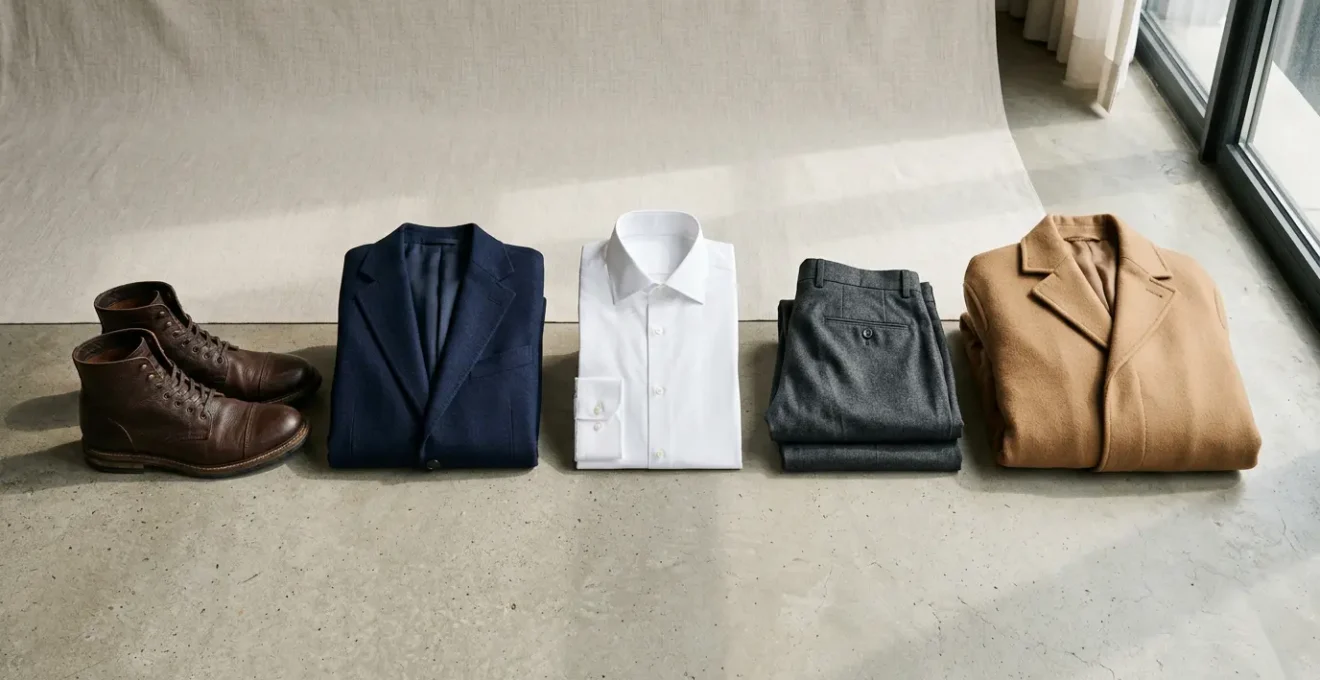
Building a timeless wardrobe isn’t about a magic list of items, but about applying five core architectural principles to create a functional system.
- True value is measured in « cost-per-wear, » not the initial price tag.
- A bespoke fit, achieved through tailoring, is the most effective way to elevate off-the-rack garments.
- A data-driven closet audit reveals your true style, forming the blueprint for a functional wardrobe.
Recommendation: Start by tracking what you actually wear for two weeks. This data is the foundation of your personal wardrobe architecture, revealing the « uniforms » that define your core aesthetic.
The paradox is familiar: a closet overflowing with clothes, yet a persistent feeling of having « nothing to wear. » This frustration often sends us searching for solutions, typically in the form of lists— »the 10 essential items every woman must own, » « the five timeless pieces for men. » We’re told a classic trench coat, a crisp white shirt, or the perfect blue jeans are the answer. While these items have merit, this item-based approach is a fundamental flaw in wardrobe construction. It treats clothing like a collection of disconnected objects rather than a cohesive, functional system.
This strategy addresses the symptoms—the feeling of being overwhelmed—but not the root cause: the lack of a structural blueprint. The real problem isn’t a deficiency of specific items, but the absence of an architectural framework. You wouldn’t build a house by randomly buying beautiful windows and doors; you start with a foundation and a plan that dictates how every element works together to serve a purpose. A truly resilient wardrobe, one that survives trends and serves your life, requires the same strategic thinking.
But what if the key wasn’t in *what* you buy, but in *how* you plan? This guide shifts the perspective from that of a consumer to a wardrobe architect. Instead of chasing a checklist of trendy staples, you will learn the five foundational pillars that underpin a wardrobe built for longevity, function, and personal expression. We will deconstruct the principles of quality, fit, and function, providing you with a system to transform your closet from a source of stress into a source of confidence and ease.
This article will guide you through the structural principles needed to build a wardrobe that lasts. By exploring everything from the economics of quality to the psychology of use, you will gain a comprehensive blueprint for creating a closet that is not just full, but truly functional.
Summary: The 5 Pillars of a Trend-Proof Wardrobe
- Why spending $300 on everyday boots is cheaper than $50 boots twice a year?
- 3 signs a $200 shirt is actually cheaper than four $50 alternatives
- How to tailor off-the-rack trousers to look bespoke?
- How to audit your closet in 3 hours to find your core aesthetic?
- 3 staples (like white shirts) you actually SHOULD buy in multiples
- Coat vs. Blazer: Which core piece is missing if you freeze in October?
- The mistake of not wearing your best coat daily
- How to Plan Your Wardrobe Like an Architect Plans a House?
Why spending $300 on everyday boots is cheaper than $50 boots twice a year?
The first pillar of wardrobe architecture is understanding the fundamental economic principle of Cost-Per-Wear (CPW). This metric reframes purchasing decisions away from the immediate sticker price and towards long-term value. A $50 pair of boots that lasts one season of 50 wears costs $1 per wear. A $300 pair of boots crafted with durable materials that lasts five seasons for a total of 250 wears costs $1.20 per wear in its first year, but its lifetime CPW drops significantly over time. This initial « investment » becomes cheaper with every use.
This logic directly counters the false economy of fast fashion, which thrives on low initial costs and planned obsolescence. The cycle of buying, wearing out, and replacing cheap items is not only more expensive over time but also environmentally unsustainable. A landmark federal report on textile waste reveals that nearly 17 million tons of textile waste were generated in 2018 in the U.S. alone, with the vast majority ending up in landfills. Choosing durable, repairable items is a vote against this system.
The difference lies in the structural integrity of the garment. A high-quality boot, for instance, is built with components designed for longevity and repair, such as a Goodyear-welted sole that can be replaced. These are the construction details that define a garment’s ability to endure, as highlighted in the image below.
As you can see, the dense stitching, full-grain leather, and layered sole are not merely aesthetic choices; they are engineering decisions. They ensure the boot maintains its form, protects from the elements, and can be maintained for years. This focus on material and construction is the true foundation of a cost-effective wardrobe.
3 signs a $200 shirt is actually cheaper than four $50 alternatives
Once you embrace the cost-per-wear principle, the next step is learning to identify the physical markers of quality—the « structural integrity » that justifies a higher initial investment. A $200 shirt isn’t cheaper just because it lasts longer; it’s cheaper because its construction details actively resist the decay that plagues lower-quality alternatives. Instead of relying on brand names or price tags as proxies for quality, a wardrobe architect learns to read the garment itself. There are three clear, physical signs that distinguish a piece built for longevity.
These indicators are tangible and can be assessed in the store before you ever make a purchase. They are the difference between a garment that looks good on the hanger and one that will look good after dozens of washes and years of wear. Mastering these points of inspection is a core skill for building a truly resilient wardrobe, transforming you from a passive consumer into an informed investor in your own style.
Here are three signs that a garment is built to last, making its higher price a smarter long-term investment:
- Sign 1 – The Stitch-Per-Inch Test: Examine the seams, especially around collars and buttonholes. A high-quality shirt will feature 12-18 stitches per inch. This high density ensures the seams can withstand stress and movement without puckering or breaking. Cheaper garments often have as few as 6-8 stitches, leading to quicker deterioration.
- Sign 2 – The Drape & Recovery Factor: Quality fabric has memory. Crumple a part of the shirt (like the sleeve) in your hand for 10 seconds. Premium fabrics, such as high-twist cotton or silk blends, will spring back with minimal wrinkling. This « recovery » indicates strong fibers that will maintain their shape and require less maintenance over time.
- Sign 3 – The Color Saturation Clue: Hold the fabric up to a natural light source. The color should be deep, even, and consistent, without any hint of streaking. This points to a superior dyeing process where the color has fully penetrated the fibers, making it resistant to fading. A quick test is to (discreetly) rub a damp white cloth on an inside seam; quality dyes will not transfer.
How to tailor off-the-rack trousers to look bespoke?
A garment’s quality is its foundation, but its fit is what gives it architectural form. Even the most expensive, well-made item will look cheap if it doesn’t fit your body correctly. This is where tailoring becomes a non-negotiable pillar of wardrobe construction. It is the most powerful and cost-effective tool for transforming standard off-the-rack pieces into garments that appear custom-made. The secret isn’t in buying bespoke, but in learning how to guide a tailor to achieve a bespoke *look*.
The process starts with selecting garments that have « good bones »—items made of quality fabric with the core elements (like the rise of trousers or the shoulders of a jacket) fitting well. From there, a few key alterations can redefine the entire silhouette. As the tailoring team at Articles of Style notes, the process is more art than simple science. Their philosophy underscores the importance of a human touch over rigid numbers. As they explain in their guide on bespoke tailoring, « Having exact body measurements means nothing, if you don’t understand how to balance a garment on a body and how the client likes to wear his clothes. » This highlights the collaborative relationship you should build with your tailor.
To achieve this, you must communicate your vision. Before visiting a tailor, identify the key adjustments that yield the most impact. A few simple tweaks can dramatically alter the appearance of a garment, making it a true cornerstone of your wardrobe. The goal is to create a silhouette that is both comfortable and flattering, bridging the gap between mass-market production and personal fit.
Your Action Plan: The 5 Steps to a Bespoke Fit
- Identify the ‘Good Bones’: Before buying, focus on what can’t be changed easily, like fabric quality and shoulder width. Ensure elements like the waist, hem, and leg width have enough seam allowance for adjustment.
- Master Essential Tailoring Terms: Learn to speak the language. Understand « taper » (narrowing the leg), « break » (where trousers meet the shoe), and « seat » (the fit around your hips) to clearly articulate your needs.
- Prioritize the 80/20 Alterations: Focus on hemming the length and adjusting the waist. These two alterations provide the most significant visual transformation for the lowest cost.
- Test the Fit During Pinning: When the tailor is pinning the garment, move around. Sit down, bend your knees. This ensures the final fit allows for real-world movement and comfort, not just a static standing pose.
- Communicate Your Style Preferences: Bring photos of fits you admire. Clearly explain your desired look (e.g., a « no break » modern trouser finish vs. a more traditional « slight break »). Your tailor is a skilled craftsperson, but not a mind reader.
How to audit your closet in 3 hours to find your core aesthetic?
With the principles of quality (CPW) and fit (tailoring) established, the next pillar is creating the architectural blueprint. This blueprint is your core aesthetic, and it isn’t found in a magazine or on a style blog; it’s hidden in your existing closet. A common mistake is to « declutter » by getting rid of things you don’t like. A wardrobe architect does the opposite: they start by analyzing the data of what they *actually* love and wear. This data-driven audit reveals your true, lived-in style, not your aspirational one.
The goal of this audit is not to create a restrictive « capsule wardrobe » but to identify the recurring patterns, combinations, and silhouettes that form your personal « uniforms. » These uniforms are the DNA of your style. They are the reliable outfits you reach for when you want to feel confident, comfortable, and authentic. By deconstructing them, you create a clear and actionable guide for all future purchases, effectively ending the cycle of buying items that never leave the closet.
This process requires a methodical, almost forensic approach. Instead of a vague sorting process, you will act as an analyst, tracking usage data and categorizing garments by their function in your life. This reveals not just what you like, but *why* and *when* you wear it, providing a deep understanding of your wardrobe’s functional requirements.
Your Blueprint: The 3-Hour Data-Driven Closet Audit
- Step 1 – Track Before You Audit (Weeks 1-2): Before you touch a single hanger, use your phone’s notes app to log every outfit you wear for two weeks. Note the items and the occasion. This objective data is crucial, as it reveals your habits, not your intentions.
- Step 2 – The ‘Verb’ Categorization (Hour 1): Pull everything out. Instead of sorting by type (shirts, jeans), categorize items by the life activity they serve. Create piles for ‘leading work meetings,’ ‘weekend errands,’ ‘feeling powerful,’ or ‘comfort at home.’ This maps your clothes to your life, instantly revealing functional gaps and redundancies.
- Step 3 – Deconstruct Your Top 5 Uniforms (Hours 2-3): Using your two-week data, identify the 3-5 outfits you wore most. Lay them out and analyze their components (e.g., black tapered trousers + silk blouse + blazer). These recurring combinations are the genetic code of your core aesthetic and the blueprint for any future additions.
3 staples (like white shirts) you actually SHOULD buy in multiples
Once your architectural blueprint is defined, the next pillar is building for efficiency. Just as an architect uses repeating structural elements like beams or windows, a smart wardrobe builder identifies and multiplies their most effective components. This is the concept of buying in multiples—not as a form of hoarding, but as a strategic decision to reduce friction and cognitive load in your daily life. When you find a staple that perfectly fits your blueprint in terms of quality, fit, and function—like a white shirt, a specific model of t-shirt, or a perfectly cut pair of trousers—buying two or three is one of the most powerful moves you can make.
This strategy directly combats decision fatigue, the mental exhaustion that comes from making too many choices. Having proven, reliable options on hand eliminates the daily scramble and frees up mental energy for more important tasks. In fact, a study published in the International Journal of Market Research confirms that an excess of choices, often fueled by materialism, can lead to lower life satisfaction. A curated « uniform » of high-performing staples is the antidote.
The key is to apply this strategy only to the true workhorses of your wardrobe, identified through your closet audit. These are not trend-driven pieces but the versatile foundations you build upon. For many, this includes items like:
- The perfect white t-shirt or shirt: The ultimate neutral canvas. Having several in rotation ensures a fresh one is always ready.
- Your go-to trousers or jeans: When you find a cut that is both comfortable and flattering, owning it in multiple colors (e.g., black, navy, khaki) creates an instant wardrobe system.
- Essential base layers: Items like high-quality merino wool sweaters or silk camisoles that form the foundation of your layering system.
This approach transforms dressing from a daily question into a simple, confident action. It’s about recognizing what works and leaning into it with intention.
Coat vs. Blazer: Which core piece is missing if you freeze in October?
A well-architected wardrobe doesn’t just contain beautiful pieces; it contains pieces that perform specific functions. This is the principle of functional zoning. A blazer and a coat may look similar, but they are engineered for entirely different environments and purposes. If you find yourself cold during your October commute, it’s likely a sign of a functional gap in your outerwear system. You may own several « third pieces, » but you are missing the correct « shell. »
A blazer, even a heavy wool one, is fundamentally an indoor garment. It’s designed to complete an outfit and provide a layer of warmth in a climate-controlled setting like an office or restaurant. Its construction is focused on silhouette and drape. A coat, by contrast, is an outdoor garment. Its primary function is to act as a protective shell against the elements—wind, rain, and cold. Its design prioritizes insulation, coverage, and weather resistance.
Confusing the two is a common architectural flaw. Wearing a blazer as a primary outdoor jacket in autumn is like using an interior wall to support the roof of a house; it wasn’t designed for that load. The solution is not necessarily a single, heavier coat, but a modular « layering system » where each piece has a defined role. The following table breaks down the function of each garment within this system.
| Garment Type | Primary Function | Fabric Weight | Warmth Strategy | Formality Context |
|---|---|---|---|---|
| Heavy Wool Blazer | Indoor ‘third piece’ that completes an outfit | 12-16 oz heavyweight wool | Layered over base layers; traps body heat | Professional settings, indoor events |
| Lined Coat (Trench/Wool) | Outdoor shell protecting the outfit beneath | Varies (lighter outer with insulated lining) | Wind/rain protection + insulation layer | Commuting, outdoor transitions |
| Layering System (3-part) | Adaptable outerwear ‘system’ | Merino base + blazer + packable vest | Modular warmth adjusted by activity/climate | Maximum versatility across occasions |
By understanding the specific role of each piece, you can build a wardrobe that functions like a well-designed machine, adapting to any environment without sacrificing style or comfort. Your outerwear is not one item, but a system of interlocking parts.
The mistake of not wearing your best coat daily
The final architectural pillar is psychological: you must give yourself permission to inhabit the structure you’ve built. The most common mistake after investing in high-quality, foundational pieces is to « save » them for a special occasion. This « scarcity mindset » relegates your best garments to the back of the closet, where their cost-per-wear value stagnates and their ability to enhance your daily life is lost. A well-made coat is not a fragile artifact; it is a tool designed for daily use.
Wearing your best items every day is the entire point of building a functional wardrobe. It maximizes your financial and emotional return on investment. Financially, it drives down the cost-per-wear, making the piece more economical over time. Emotionally, it integrates quality and beauty into your daily routine, boosting confidence and deriving joy from the things you own. This shift from a scarcity mindset to an abundance mindset is transformative.
This is not just a philosophical idea; it has proven psychological benefits. By reframing « special » items as everyday essentials, you reinforce a sense of self-worth and satisfaction.
Case Study: The Psychology of Daily Luxury
An exploratory study on lived experiences with capsule wardrobes found a powerful psychological shift in participants. Those who committed to wearing their highest-quality items daily reported increased self-confidence, a reduction in materialistic desires, and greater overall life satisfaction. The act of using their « best » pieces regularly transformed the garments from symbols of status into partners in their daily lives. This frequent wear allowed the items to develop a personal patina and story, which in turn enhanced their subjective value and the owner’s connection to them.
A timeless wardrobe is not a museum. It is a living, breathing system designed to support and elevate your life, day in and day out. The most expensive coat is the one you never wear.
Key takeaways
- Think Like an Architect, Not a Shopper: A timeless wardrobe is a planned system, not a random collection of items.
- Value is Cost-Per-Wear: The true cost of an item is its price divided by the number of times you wear it. Invest in durability.
- Fit is Paramount: Tailoring is not a luxury; it’s the mechanism that transforms good pieces into perfect structural components of your wardrobe.
How to Plan Your Wardrobe Like an Architect Plans a House?
We have now assembled the pillars of a trend-proof wardrobe: an economic model based on cost-per-wear, an eye for structural quality, a commitment to bespoke fit, a data-driven personal blueprint, and a mindset of daily use. The final step is to synthesize these principles into a single, cohesive methodology: planning your wardrobe with the same rigor an architect uses to design a house. This means moving from reactive purchasing to proactive, systematic planning.
This architectural approach starts with a « site analysis »—your lifestyle audit—to determine your functional needs. It then establishes the « foundation and frame » with core, high-quality garments. Finally, it adds « interior finishes » with accessories and accents that express personality without compromising the structural integrity of the whole. This system creates a wardrobe that is both resilient and adaptable.
This is not a theoretical exercise. Companies at the forefront of modern tailoring are already using this framework to build wardrobes for their clients, proving its real-world effectiveness.
Framework in Action: The Articles of Style Architectural Method
The online bespoke tailor Articles of Style explicitly uses an architectural framework to build client wardrobes. As detailed in their process breakdown, they treat garments as modular components within a planned system. Their method begins with a lifestyle audit to define functional needs (the ‘site analysis’). From there, they build the ‘foundation and frame’ using five core categories: structured outerwear, tailored trousers, versatile shirts, quality footwear, and layering pieces, all constructed with premium materials and a precise fit. Only then are ‘interior finishes’—accessories, seasonal colors, and smaller trend items—added to inject personality. This ensures the core structure remains timeless, while the accents can evolve, preventing the need for costly seasonal overhauls.
By adopting this mindset, you are no longer a passive consumer caught in trend cycles. You become the architect of your own style, in full control of a system designed to serve you for years to come.
Begin today by conducting your own two-week data-driven audit. This simple act of observation is the first step in designing a wardrobe that works for you, not against you, and finally solving the « nothing to wear » paradox.