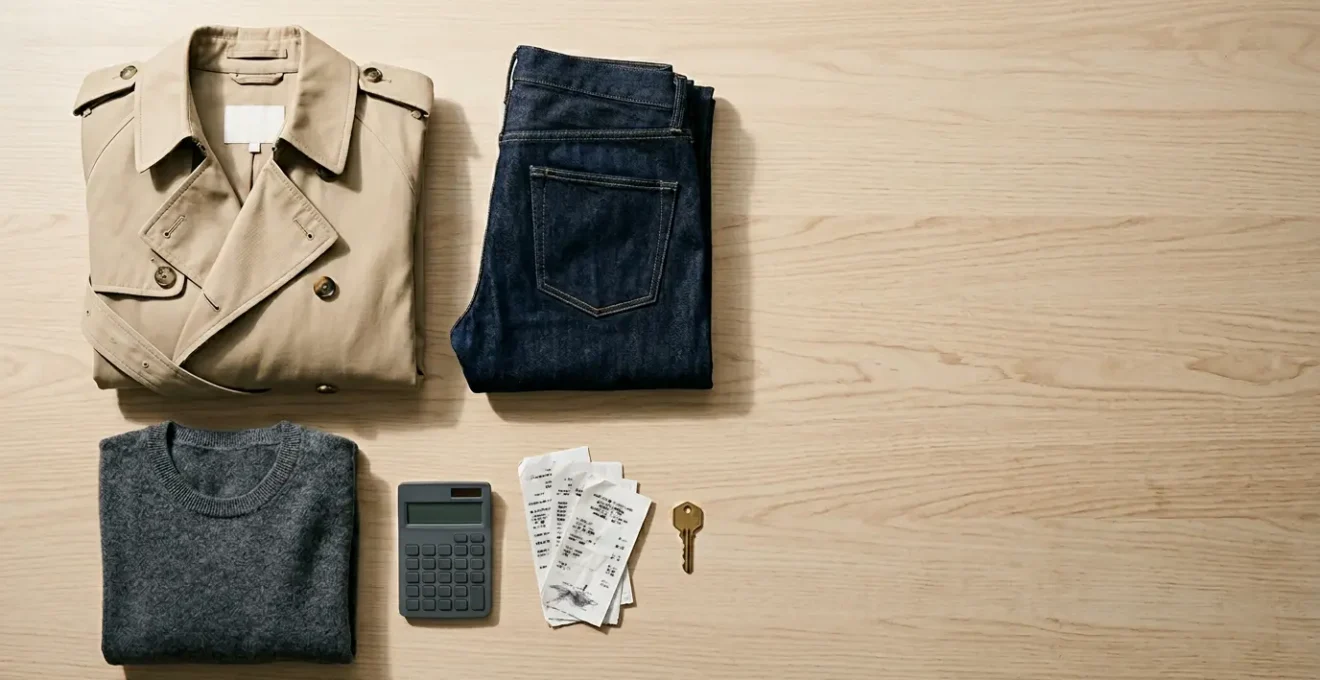
Contrary to popular belief, a high-quality capsule wardrobe can be financially superior to fast fashion within the first 12 months.
- High upfront costs are offset by liquidating your old wardrobe and eliminating avoided impulse purchases.
- Quality items act as appreciating assets with significant resale value, unlike fast fashion which depreciates to near zero.
Recommendation: Treat your wardrobe as a portfolio. The key is analyzing cost-per-wear and value retention, not just the initial price tag.
The idea of a capsule wardrobe is often sold with a simple mantra: « buy less, buy better. » For the skeptic, this raises an immediate and valid financial question. How can spending $500 on a single trench coat possibly be cheaper than a $70 alternative, especially within the first year? The high upfront cost seems like a barrier, a luxury that only pays off in a vague, distant « long run. » This perspective, however, misses the fundamental financial mechanics at play.
This is not an article about minimalist philosophy; it is a balance sheet. We will approach your wardrobe as an accountant would: analyzing assets, depreciation, return on investment (ROI), and risk mitigation. The argument is not just that a capsule is cheaper *eventually*, but that the net cost in the very first year can be significantly lower when you factor in the resale value of your old clothes, the structural failure of cheap items, and the quantifiable value of quality.
We will break down the specific, tangible markers of quality that determine an item’s financial longevity. Forget abstract notions of « timeless style. » We are talking about the difference between fused and canvassed construction, the pilling resistance of a fabric, and the engineering of a waistband. By shifting the mindset from « spending on clothes » to « investing in a portfolio of wearable assets, » the first-year math changes dramatically.
This guide provides a complete financial framework for building a capsule wardrobe. From identifying items that hold their value to liquidating old inventory, each section is a step in a strategic, number-driven process.
Summary: A Financial Audit: Is a Capsule Wardrobe Truly Cheaper in Year One?
- Why designer trenches hold 60% value while high street ones hold 0%?
- How to rub test fabric in-store to ensure it won’t pill in a month?
- Elastic vs. Fixed Waist: Which capsule bottoms survive weight changes?
- The mistake of buying only plain items and hating your style
- 3 steps to sell your old clothes to fund the new capsule piece
- Why fused lining bubbles after dry cleaning unlike canvas construction?
- How to identify fake cashmere quality in under 30 seconds in-store?
- Can You Survive With Only 33 Items in Your Wardrobe for 3 Months?
Why designer trenches hold 60% value while high street ones hold 0%?
The single most important financial shift in building a capsule wardrobe is viewing clothing not as a consumable good, but as an asset with a measurable resale value. A fast-fashion item is a 100% loss the moment you purchase it. A high-quality heritage piece, however, is a tangible asset that retains, and can even exceed, its initial value. This isn’t an opinion; it’s a market reality. For instance, some heritage luxury brands demonstrate remarkable financial performance, with certain Hermès items showing 138% value retention, effectively appreciating like a stock.
While not every capsule piece is an Hermès bag, the principle of value retention applies across the board. The difference between a designer trench coat and a high-street version lies in construction, materials, and brand equity—factors that the resale market quantifies. A cheap trench is an expense. An expensive trench is a less liquid, but still tangible, asset. In your first-year budget, a $500 trench that you can resell for $300 a year later has a true cost of only $200. A $70 trench that is worthless after one season has a true cost of $70, plus the replacement cost.
This table breaks down the stark reality of asset depreciation in fashion. Heritage and « quiet luxury » items function more like investments, holding or increasing their value, while fast fashion is a guaranteed write-off.
| Brand Category | Example Brands | Average Value Retention | Market Performance 2024 |
|---|---|---|---|
| Heritage Luxury | Hermès, Chanel | 105-138% | Exceed original retail price |
| Quiet Luxury | The Row, Toteme | 85-106% | GMV up 26-76% YoY |
| Premium High-Street | Diffusion lines | 10-30% | Rapid depreciation |
| Fast Fashion | High-street brands | 0-5% | Near-zero resale value |
Understanding this depreciation curve is the first step in making financially sound wardrobe decisions. You are not just buying a coat; you are choosing an asset class.
How to rub test fabric in-store to ensure it won’t pill in a month?
An item’s value retention is directly tied to its physical durability. Pilling—the formation of small fuzzballs on a fabric’s surface—is a primary indicator of poor-quality fiber and a fast track to a zero-dollar resale value. This is a predictable failure point that can be identified in-store with simple, tactile due diligence. Performing a quick fabric test is like checking the engine of a car before buying; it’s a crucial step to avoid a bad investment.
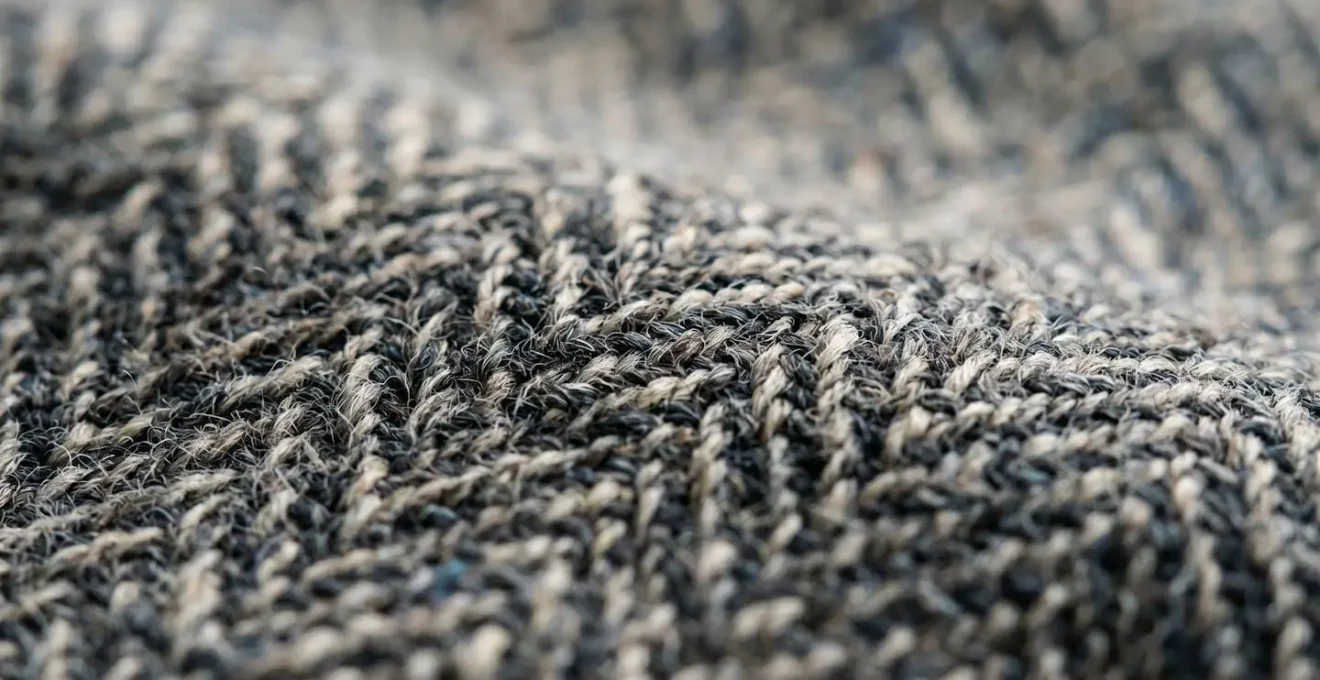
This image shows the intricate, tight weave of a high-quality fabric. This density is what resists the friction that causes pilling, ensuring the garment maintains its smooth finish and, therefore, its value over time.
The financial metric to apply here is Cost Per Wear (CPW). A cheap sweater that pills after five wears has a disastrously high CPW. For example, a $30 sweater worn only 5 times before it looks shabby costs $6 per wear. In contrast, a $150 sweater made from high-quality, pill-resistant fiber that you wear 100 times has a CPW of just $1.50. The higher upfront cost is amortized over a much longer, more reliable lifespan, a core principle of the cost-per-wear formula for wardrobe investment. Learning to spot durability is a direct path to lowering your long-term clothing expenditure.
Use this three-part protocol in the dressing room. It takes less than a minute and can save you from a poor investment that will depreciate to zero within weeks.
- Light Test: Hold the fabric up to a light source. A tight, dense weave with minimal light passing through indicates higher quality and a lower propensity for pilling. If you can see through it easily, the fibers are loose and will likely break down quickly.
- Rub Test: In a discreet area, gently but briskly rub the fabric against itself for 10-15 seconds. High-quality fabric will show minimal change. Low-quality material will immediately start to fuzz as weak fibers break and tangle.
- Stretch & Recovery Test: Gently pull the fabric and watch how it snaps back. Quality materials, especially those with well-integrated elastane, will return to their original shape instantly. Poor fabrics will sag or look slightly stretched out, indicating a weak structure that will deform with wear.
These tests are not just about aesthetics; they are a financial forecast. A fabric that fails these simple checks is guaranteed to have a high CPW and a resale value of nothing.
Elastic vs. Fixed Waist: Which capsule bottoms survive weight changes?
A core principle of a capsule wardrobe is longevity, and nothing undermines an item’s lifespan faster than a poor fit due to natural body fluctuations. A pair of trousers or a skirt with a fixed, unchangeable waist is a high-risk investment. A minor weight change of just 5-10 pounds can render it unwearable, instantly tanking its Cost Per Wear and forcing an additional, unplanned expense: tailoring. These alteration costs, typically ranging from $20-40 per waist adjustment, are a hidden tax on inflexible design.
From a financial perspective, choosing garments with built-in adaptability is a form of insurance. Features like wrap closures, high-quality elastic panels, or traditional side-tab adjusters provide a buffer against minor changes, dramatically extending the garment’s wearable life and thus maximizing its ROI. A fixed-waist garment has a single point of failure. An adaptable garment has a built-in contingency plan.
When evaluating bottoms for your capsule, consider this hierarchy of adaptability. The most flexible options offer the greatest long-term value by accommodating a wider range of fit without incurring extra costs.
- Wrap closures: The most adaptable, easily accommodating a 10-15 lb fluctuation through a simple re-tying system. This offers maximum longevity.
- Drawstring waistbands: Highly versatile, offering an 8-12 lb accommodation range. Excellent for casual and « athleisure » capsule pieces.
- Side-tab adjusters: A classic tailoring feature that allows for a 2-3 inch waist adjustment (around 5-8 lbs) while maintaining a clean, structured look.
- High-quality back-elastic panels: Provides 1-2 inches of stretch for comfort and minor fluctuations without compromising the front’s flat appearance.
- Fixed waist with generous seam allowance: The least flexible option, but a large seam allowance allows a tailor to make a one-time adjustment if needed. This should be a last resort.
Choosing a more forgiving design is not a compromise on style; it’s a strategic decision to protect your investment and ensure your core pieces remain functional assets for years, not months.
The mistake of buying only plain items and hating your style
A common pitfall in early capsule wardrobe attempts is overcorrecting into a sea of beige, black, and white basics. While neutrals are foundational, a wardrobe devoid of personality leads to boredom, which in turn triggers the very impulse buys the capsule was meant to prevent. The data supports this: research shows that on average, only 20% of the items in a person’s closet are regularly worn. Often, the unworn 80% are a mix of failed basics and regretted impulse purchases bought to inject some « fun. »
The accountant’s approach is not to eliminate personality but to budget for it strategically. You need « statement » or « accent » pieces, but they should not be permanent, depreciating assets if you’ll only wear them a few times. This is where a hybrid model can be financially brilliant.
Case Study: The Clothing Rental ‘Fun’ Budget
Clothing rental services offer a financially savvy solution to the style boredom problem. Instead of purchasing a trendy, seasonal blazer for $200 that you might wear four times (a CPW of $50), you can rent a variety of statement pieces for a fixed monthly fee. This allows you to experiment with trends and inject personality into your core capsule without accumulating rarely-worn items that clog your closet and balance sheet. It turns the desire for novelty from a capital expenditure into a predictable operational expense, protecting your core investments.
A successful capsule requires a 70/30 or 80/20 balance. 70-80% of your capsule should be high-quality, versatile core items that do the heavy lifting. The remaining 20-30% is your personality layer: a uniquely textured sweater, a boldly colored blouse, or a signature piece of jewelry. These are the items that make the wardrobe feel like *yours*. For items where your taste might be fleeting, renting is the most fiscally responsible choice.
This balanced approach prevents the « closet full of nothing to wear » paradox and ensures your carefully curated assets are actually used, maximizing their cost-per-wear and your personal satisfaction.
3 steps to sell your old clothes to fund the new capsule piece
The high upfront cost of a capsule wardrobe is often the biggest deterrent. However, this is calculated in a vacuum. The reality is you are sitting on a source of funding: your old, bloated wardrobe. Liquidating these underutilized assets is the critical first step to financing your new, high-quality pieces. The online resale market is not a niche hobby; it’s a booming economy. For context, reports show the online resale market in the US is forecast to grow 16% annually, reaching $34 billion by 2027.
The process involves three key stages: auditing your current inventory, choosing the right sales platform for maximum ROI, and timing your sales to match market demand. Each platform offers a different balance of potential return versus personal effort. A high-value designer bag requires a different strategy than a contemporary brand dress.
This matrix outlines the financial trade-offs of the most common resale channels. Use it to decide where to list your items for the best possible return on your time and assets.
| Platform Type | Potential Return | Effort Level | Best For | Processing Time |
|---|---|---|---|---|
| The RealReal | High (60-70% of resale value) | High (authentication, photos, description) | Luxury items $500+ | 2-4 weeks |
| Poshmark/Depop | Medium (keep 80% after fees) | High (self-managed listing, shipping) | Contemporary brands $50-500 | Immediate to 2 weeks |
| Local Consignment | Lower (40-50% split) | Medium (drop-off only) | All price ranges, local market | 30-90 days |
| Brand Trade-In Programs | Store credit (often 20-30% above cash value) | Low (simple drop-off) | Same-brand repurchase | Immediate credit |
Before you can sell, you must know what you have. Conduct a thorough audit of your wardrobe to identify viable assets for liquidation.
Your 5-Step Wardrobe Liquidation Audit
- Inventory & Categorize: List every item you intend to sell. Categorize by type (e.g., winter coats, work trousers) and brand tier (luxury, contemporary, high-street).
- Condition Assessment: Honestly grade each item on a scale of 1-5 (New with Tags, Excellent, Good, Fair, Poor). Be ruthless; items in Fair or Poor condition are unlikely to sell and should be considered for donation or recycling.
- Market Research: Spend 30 minutes on your chosen platform (e.g., Poshmark) searching for similar items. Note the average selling price for items in a similar condition. This establishes a realistic price expectation.
- Calculate Net Profit: For your top 5-10 items, subtract the platform’s commission and estimated shipping costs from your expected selling price. This is your projected net profit.
- Prioritization Plan: Rank your items by potential net profit. Focus your initial energy on listing the top 5 most profitable items first to generate momentum and capital quickly.
Treating this decluttering process as a business liquidation, not just a spring clean, is what transforms the cost of a capsule from an insurmountable expense into a manageable asset reallocation.
Why fused lining bubbles after dry cleaning unlike canvas construction?
A blazer or tailored coat is often a cornerstone investment in a capsule wardrobe. The difference between a $150 fast-fashion blazer and a $900 tailored one often lies in an invisible detail: its internal construction. Cheaper jackets use a fused lining, where the inner structure is glued to the outer fabric. High-quality jackets use a canvassed construction, where an internal layer of horsehair canvas is stitched to the fabric, allowing it to float and move naturally.
This isn’t just a matter of tailoring snobbery; it has direct and predictable financial consequences. The heat and chemicals of dry cleaning break down the glue in fused jackets, causing the dreaded « bubbling » on the lapels and chest. This damage is irreversible and destroys the garment’s appearance and value. A canvassed jacket, held together by stitches, molds better to your body over time and withstands decades of cleaning. A longevity analysis shows a $500 fused blazer may fail after 3-5 cleanings, while a $900 canvassed one can endure 50+, making its true long-term cost far lower.
You can identify the construction type in-store with a simple tactile test, as demonstrated by the hands in this image examining the lapel’s layers.

This is a critical piece of due diligence. A jacket that will self-destruct after a few trips to the cleaner is not an asset; it’s a liability with a guaranteed short lifespan. Here’s how to perform the test yourself:
- The Lapel Pinch Test: Gently pinch the outer fabric and the lining of the lapel between your thumb and forefinger. Try to roll the layers apart. If you can feel a distinct, separate, floating layer of fabric in between, it is a canvassed (or half-canvassed) jacket. This is the sign of a durable investment.
- The Single-Layer Feel: If the lapel feels like one single, stiff piece of fabric and you cannot separate any layers, it is fused. The adhesive has bonded everything together. This construction is cheaper to produce but has a very limited lifespan.
- Drape Observation: Hold the jacket by its shoulders. A canvassed jacket’s lapel will have a natural, gentle roll and drape. A fused lapel will look flatter, stiffer, and more rigid.
Choosing canvassed construction is a clear-cut financial decision. You are paying more upfront to eliminate a known, costly, and inevitable point of failure.
How to identify fake cashmere quality in under 30 seconds in-store?
Cashmere is a prime example of a luxury material where the label can be deeply misleading. A sweater tagged « 100% Cashmere » can range from a durable, multi-year investment to a low-grade imposter that pills and loses shape after two washes. The market is flooded with low-quality cashmere made from short, brittle fibers or, even worse, synthetic blends deceptively labeled. As an investor in your wardrobe, learning to spot « fake » or poor-quality cashmere is a vital fraud-detection skill.
The most immediate red flag is an unrealistic price. Authentic, high-quality cashmere is expensive due to the scarcity of the long fibers from a goat’s undercoat. According to luxury resale market authentication standards, a genuine quality cashmere garment will almost always cost a minimum of $50-$150. A thick « 100% cashmere » sweater priced at $50 is a physical and economic impossibility; you are likely buying over-brushed wool or a viscose blend.
Beyond price, a few tactile and visual tests can reveal the truth in under 30 seconds. Your goal is to assess fiber length and density, the two key predictors of quality and longevity.
- Surface Test: Gently run your hand over the surface. High-quality cashmere has a very subtle, short « halo » of fibers. It should feel soft but not excessively fluffy. A super-fluffy surface is a major warning sign; manufacturers often over-brush low-quality, short fibers to make them feel soft in the store, but these are the very fibers that will break and pill instantly.
- Density Test: Hold the sweater up to a light. A quality cashmere knit should be dense and opaque. You should not be able to see clearly through the weave. A loose, web-like pattern indicates that less material was used, and the structure will not hold up.
- Weight Test: Quality cashmere has a satisfying weight relative to its size because of its fiber density. A suspiciously lightweight « cashmere » piece indicates either a blend with cheaper, lighter fibers or a very low-grade, sparse knit.
- Label Reading: Always check the fine print on the fabric content tag. Deceptive but legal labels like « 95% Viscose, 5% Cashmere » can be sold as a « cashmere blend, » but the garment will perform like a cheap synthetic.
By applying this financial and physical scrutiny, you ensure that when you invest in cashmere, you are acquiring a genuine, long-lasting asset, not a disposable imitation.
Key Takeaways
- A capsule wardrobe’s financial viability depends on treating clothing as assets, focusing on value retention and resale potential, not just the initial price.
- The true cost of an item is its Cost Per Wear (CPW), which is minimized by investing in durable construction and materials that resist predictable failure points like pilling and bubbling.
- Financing a high-quality capsule is achieved by systematically liquidating your existing, underutilized wardrobe and avoiding future impulse buys through strategic planning.
Can You Survive With Only 33 Items in Your Wardrobe for 3 Months?
The thought of culling a wardrobe down to just 33 items can feel extreme. However, from a financial analyst’s perspective, challenges like « Project 333 » (living with 33 items for 3 months) are not about deprivation. They are an invaluable, low-cost financial diagnostic tool. Before investing thousands of dollars into a permanent capsule, you need data on your actual needs. A three-month trial run provides exactly that.
Instead of guessing what you’ll wear, you gather empirical evidence. The goal isn’t to perfectly predict your ideal wardrobe on day one, but to run a pilot program using your existing clothes to identify usage patterns, true lifestyle needs, and critical wardrobe gaps. This turns a style challenge into an intelligence-gathering mission.
Case Study: Project 333 as a Financial Diagnostic Tool
Project 333, when framed financially, serves as a zero-cost ‘pilot program’ to de-risk a future investment in a capsule wardrobe. By forcing reliance on a limited set of existing clothes, participants gather crucial data. They discover their most-worn items, calculating real-world Cost-Per-Wear. More importantly, they identify specific gaps—not ‘I have nothing to wear,’ but ‘I needed a second smart-casual blazer for work events.’ This 3-month data-gathering phase transforms abstract wants into an actionable, evidence-based shopping list, ensuring future investments are precise and necessary.
At the end of the 90-day period, the crucial work begins: the financial debrief. You now have a rich dataset to analyze. This analysis is what will form the blueprint for your real, permanent capsule wardrobe investment, ensuring every dollar is spent with purpose.
Your Post-Challenge Financial Debrief Framework
- Calculate Total Savings: Document the exact amount of money saved from eliminated impulse purchases during the 3-month period. Many participants report a 30-50% reduction in clothing spend. This is your first tangible ROI.
- Identify Cost-Per-Wear Winners: Rank your 33 items by how many times you actually wore each one. Items worn 20+ times in 90 days are your workhorses and have an excellent CPW. These are the styles to invest in.
- Map True Wardrobe Gaps: List the specific, recurring situations where you felt under-equipped (e.g., ‘lacked versatile waterproof shoes,’ ‘needed one more formal top’). This list becomes your priority investment plan.
- Analyze ‘Mistake’ Purchases: Identify any items within your 33 that you rarely or never wore. Analyze *why*. Was the fit wrong? The color difficult? Understanding these mistakes prevents you from repeating them with expensive new items.
Your journey to a financially sound wardrobe begins not with a shopping spree, but with an audit. Start your ‘Project 333’ diagnostic this week to gather the data you need to build a smarter, more valuable collection.