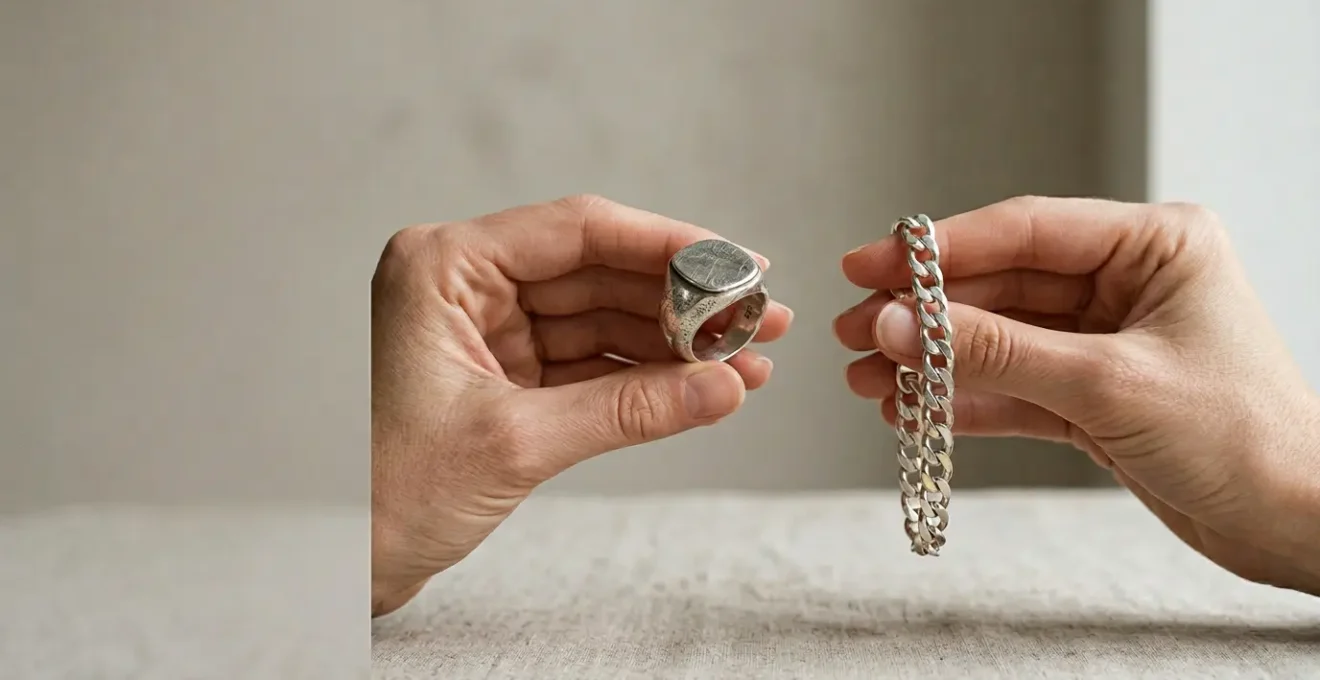
The choice between sterling silver and silver-plated jewelry is not about the initial price; it’s a technical decision between investing in lasting structural integrity and purchasing a temporary aesthetic.
- Sterling silver is a durable, repairable precious metal alloy ideal for long-term, daily wear.
- Silver-plated jewelry consists of a microscopic silver layer over a base metal (like copper), which will inevitably wear away, causing skin reactions and discoloration.
Recommendation: For a daily-wear accessory that functions as a professional trademark, analyze the cost-per-wear. Sterling silver is almost always the superior long-term investment.
The frustration is common: a favorite ring leaves a green or black stain on your finger, or a once-brilliant necklace now reveals a dull, coppery undertone. This experience often pushes buyers into a simple debate of « cheap » versus « expensive. » However, as a metalsmith, I can tell you the true difference between silver-plated and sterling silver jewelry lies not just in price, but in fundamental chemistry and structural integrity. Understanding this distinction is the key to moving beyond disposable accessories and investing in pieces that last.
Most discussions stop at the surface level: sterling is an alloy, and plated is a coating. This is true, but it doesn’t explain why one piece tarnishes in a humid bathroom while another survives, or why one can be restored to its original glory and the other is destined for the bin. It’s about understanding how these materials react to their environment—the air you breathe, the products you use, and the water you swim in.
This guide abandons the simplistic « good vs. bad » narrative. Instead, we will take a technical approach. We will examine the chemical reactions that cause discoloration, the critical mistakes that cause irreversible damage, and the methods to identify true quality. The goal is to empower you to choose jewelry not based on its initial cost, but on its intended lifespan and its true cost-per-wear. By the end, you’ll be able to select an accessory that is not just an adornment, but a reliable, professional trademark.
This article provides a technical and practical breakdown to help you make an informed choice. You will learn to identify quality, understand material behavior, and manage the lifecycle of every piece in your collection.
Summary: Sterling Silver vs. Silver Plated: A Metalsmith’s Guide
- Why your silver turns black faster in humid environments?
- How to clean silver with baking soda when you don’t have polish?
- Gold and Silver: How to stack rings without looking messy?
- The chlorine mistake that ruins silver finish instantly
- 3 hallmarks to look for to ensure you are buying real 925 silver
- How to prevent your $20 statement necklace from turning copper?
- How to choose one accessory that becomes your professional trademark?
- How to Wear Statement Earrings at Work Without Distracting From Your Pitch?
Why your silver turns black faster in humid environments?
The dark film that appears on silver, known as tarnish, is not dirt or a sign of poor quality. It is the result of a specific chemical reaction. The silver is reacting with sulfur compounds present in the air, creating a layer of silver sulfide (Ag₂S) on the surface. This is a natural process for sterling silver, but certain conditions drastically accelerate it. Humidity is the primary catalyst. Water molecules in the air act as a medium, facilitating the reaction between the silver and airborne sulfur.
This is why jewelry left in a bathroom or stored in a humid climate will tarnish significantly faster than pieces kept in a dry environment. In fact, research confirms that 54% relative humidity produces over twice the tarnish rate compared to 0% humidity. The higher the moisture content in the air, the more rapidly your silver will develop that characteristic black layer. For silver-plated items, this is even more problematic, as the moisture can also accelerate the corrosion of the underlying base metal once the thin silver layer is compromised.
To combat this, proper storage is non-negotiable. Keep your silver in an anti-tarnish pouch or an airtight box, ideally with a silica gel packet to absorb excess moisture. This creates a micro-environment that starves the chemical reaction of its key ingredient: water. For those living in persistently humid areas, choosing modern alloys can be a game-changer.
Case Study: Argentium Silver – The Tarnish-Resistant Alloy
To address the inherent problem of tarnishing, a modern alloy called Argentium silver was developed. Patented in 1998, it modifies the traditional sterling formula by replacing some of the copper with the metalloid germanium. This innovation creates a transparent, self-repairing layer of germanium oxide on the surface. This layer acts as a barrier, preventing atmospheric sulfur from reaching and reacting with the silver. As a result, Argentium is up to seven times more tarnish-resistant than standard 925 sterling silver, making it an excellent choice for daily wear, especially in high-humidity climates where traditional silver would require constant maintenance.
How to clean silver with baking soda when you don’t have polish?
When you lack commercial silver polish, a simple and effective cleaning method relies on basic chemistry: an electrochemical reaction using baking soda and aluminum foil. This process reverses the tarnishing reaction, converting the silver sulfide (the black tarnish) back into silver without abrasively removing any of the metal. It is far superior to using toothpaste or other harsh abrasives, which can scratch the surface of your jewelry.
Here is the technical process for this at-home, non-destructive cleaning method:
- Prepare the setup: Line a small, heat-proof bowl with a sheet of aluminum foil, shiny side up. The foil is a critical component; it will act as an electrode in the reaction.
- Add the reagents: Place the tarnished silver jewelry directly onto the foil. Sprinkle a generous tablespoon of baking soda (sodium bicarbonate) over the jewelry.
- Activate the reaction: Pour hot (not boiling) water into the bowl, enough to completely submerge the jewelry. You will notice a slight bubbling and may smell a faint « rotten egg » odor. This is the sulfur being released from the silver sulfide.
- Let it work: Allow the jewelry to sit for 5 to 10 minutes. The tarnish will visibly start to disappear. The chemical process at play is an ion exchange. The aluminum has a stronger affinity for sulfur than silver does. The baking soda solution acts as an electrolyte, allowing sulfur atoms to transfer from the silver sulfide to the aluminum, forming aluminum sulfide.
- Rinse and dry: Carefully remove the jewelry from the hot water with tongs. Rinse it thoroughly under cool running water to remove any residual baking soda, and then pat it completely dry with a soft, lint-free cloth.
This method is safe for solid sterling silver but should be used with caution on silver-plated items, as it can sometimes expose weaknesses in the plating. It is also not suitable for jewelry with porous gemstones like opals or pearls, or pieces with intentionally oxidized (darkened) details, as it will remove that patina.
Gold and Silver: How to stack rings without looking messy?
Mixing metals, particularly gold and silver, has evolved from a fashion faux pas to a sophisticated statement. However, achieving an elegant, intentional look rather than a chaotic jumble requires a strategic approach. The key is not to simply throw different rings on your fingers, but to build a cohesive composition based on balance, proportion, and a unifying element. A well-executed mixed-metal stack looks curated and confident.
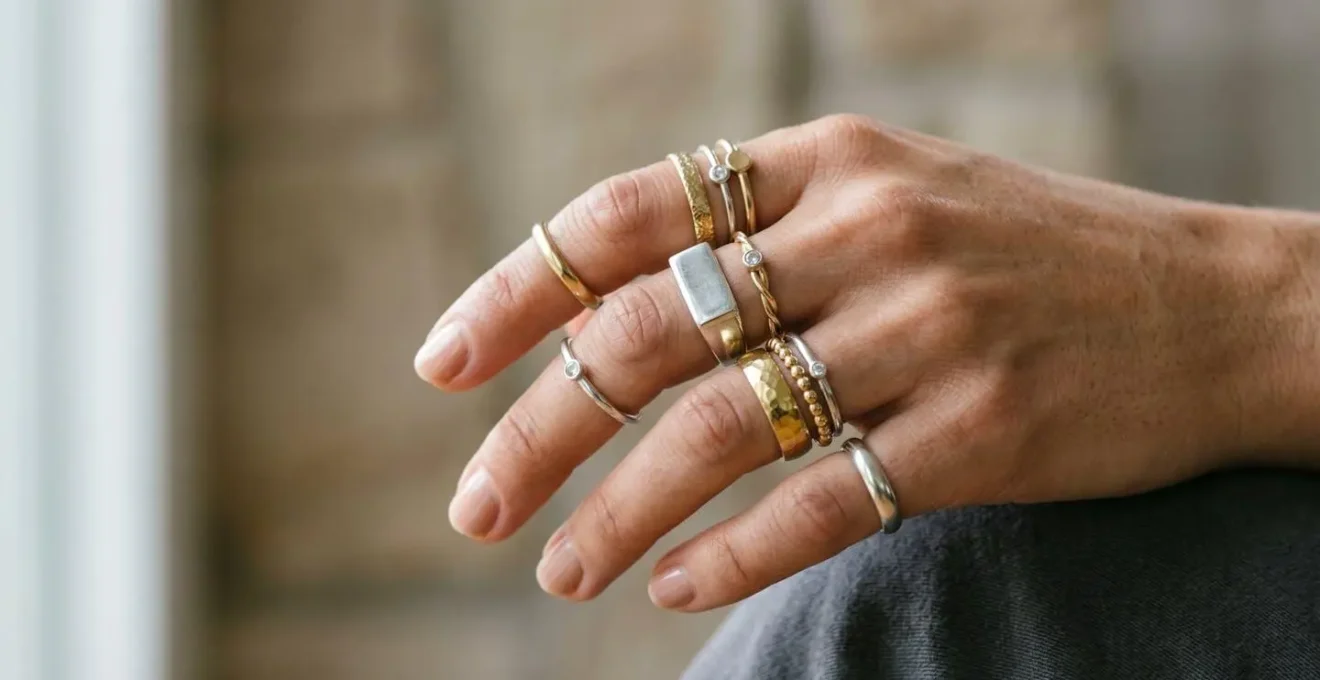
As seen in the image, a successful stack often relies on a few core principles. First is the concept of a « bridge » piece. This is a single ring that incorporates both gold and silver, or a two-tone design, which acts as a visual anchor that justifies the presence of both metals. It makes the entire combination feel deliberate. Second, maintain a consistent style or theme. If you’re stacking delicate, minimalist bands, keep all the rings in that style. If you prefer bold, organic shapes, stick to that aesthetic across both metals.
Proportion is also critical. Vary the thickness and texture of the rings to create visual interest. A common technique is to stack several thin, delicate bands next to one or two wider, more substantial rings. Don’t be afraid to leave some space; you don’t need to stack rings on every finger. A well-balanced look might involve a stack of three rings on one finger, a single statement ring on another, and leaving the rest bare. The goal is to create a focal point without overwhelming the hand. The choice of high-quality materials like sterling silver and solid gold is paramount, as their inherent luster and weight contribute to a more premium, less « messy » appearance than their plated counterparts.
The chlorine mistake that ruins silver finish instantly
While many people are aware that tarnish can be cleaned, few understand the permanent and destructive effect that chlorine has on silver jewelry. Chlorine, found in swimming pools, hot tubs, and household cleaners, does not cause tarnish (silver sulfide); it causes irreversible corrosion by creating silver chloride. This chemical reaction physically eats away at the metal, causing pitting, a dull whitish-gray film, and structural weakness.
For sterling silver, prolonged exposure can lead to stress corrosion cracking, especially at solder joints or in detailed areas. The damage is often invisible at first but compromises the piece’s integrity. For silver-plated jewelry, the effect is catastrophic and immediate. The extremely thin layer of silver can be completely stripped away in a single exposure, permanently revealing the copper or brass base metal underneath. This damage cannot be polished away.
The danger is significantly amplified by heat. Hot tubs are particularly hazardous because the elevated temperature accelerates the chemical reaction. While data on silver is less common, one laboratory study found that 14-karat gold prongs failed in just 21 hours in a heated chlorine solution, versus 120 hours at room temperature. This demonstrates the exponential increase in corrosive power with heat, a principle that applies directly to silver as well. The most critical rule for jewelry care is to always remove your silver pieces before entering a pool or hot tub. If accidental exposure occurs, immediate action is required to mitigate the damage.
If your silver jewelry is accidentally exposed to chlorine, follow this emergency protocol immediately:
- Rinse Immediately: Remove the jewelry and rinse it thoroughly under clean, lukewarm running water for at least one full minute to wash away surface chlorine.
- Neutralize with Soap: Gently wash the piece with a pH-neutral, fragrance-free soap and a soft-bristled brush to clean crevices where chlorine may be trapped.
- Rinse Again: A second thorough rinse is crucial to remove all soap and any remaining chemical residues.
- Dry Completely: Pat the item completely dry with a soft, lint-free cloth. Do not let it air dry, as trapped moisture can allow the chemical reaction to continue.
- Assess the Damage: Once dry, inspect the piece. If you see a dull film or pitting, the damage is likely permanent. For surface tarnish on sterling silver, a gentle polish or baking soda paste can be used, but this will not fix corrosion.
3 hallmarks to look for to ensure you are buying real 925 silver
In the marketplace, the only reliable way to distinguish genuine sterling silver from a silver-plated imitation is by examining its hallmarks. These small stamps, typically found on an inconspicuous part of the jewelry like the inside of a ring or near the clasp, are a legal guarantee of the metal’s purity. A piece advertised as « silver » without these marks is almost certainly plated. As a buyer, training your eye to find and interpret these marks is your most powerful tool.
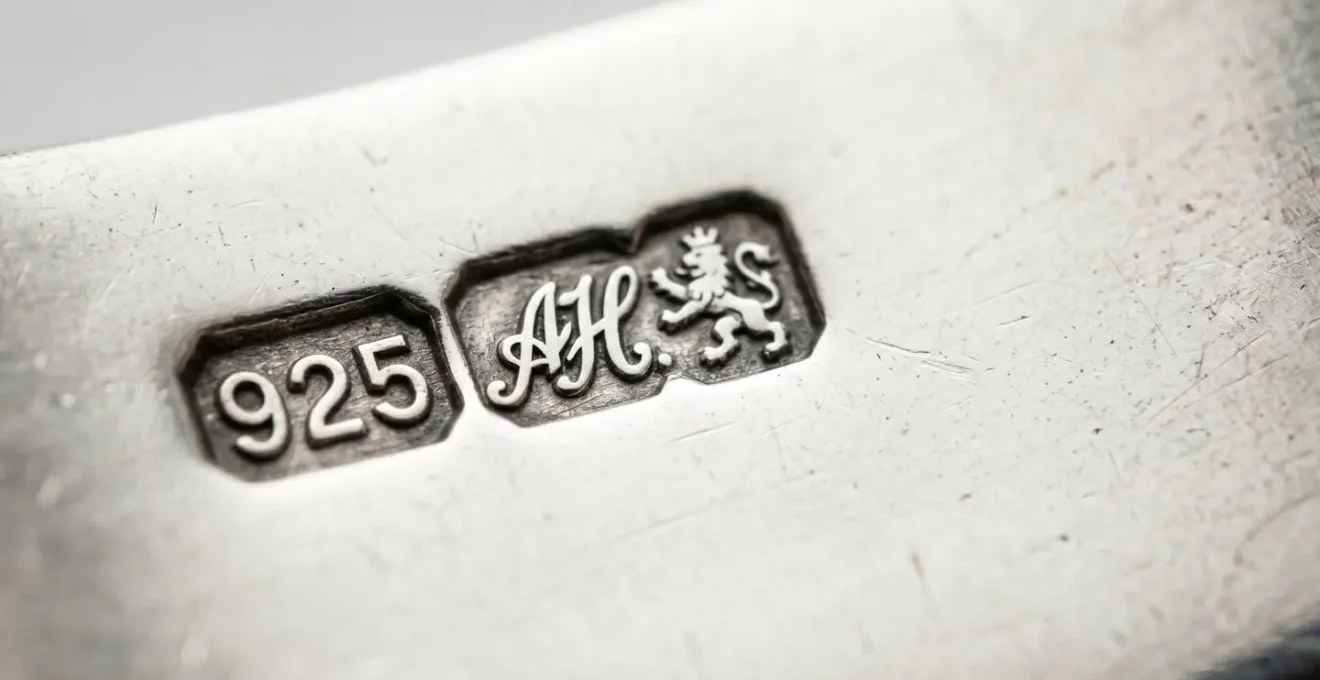
The stamps provide a wealth of information beyond simple purity. They speak to the piece’s origin, its creator, and its adherence to quality standards. Learning to read them is like learning the language of precious metals. Counterfeiters may try to replicate these marks, but genuine hallmarks have a crispness and precision that forgeries often lack. A magnifying glass or a jeweler’s loupe is an invaluable aid in this process, allowing you to assess the quality of the stamp itself. A blurry, shallow, or uneven mark should be an immediate red flag.
Ultimately, hallmarks represent accountability. A maker who takes the time to stamp their work with both a purity mark and a unique identifier is standing behind their product’s quality and material composition. Trusting these marks is the foundation of making a smart, lasting jewelry purchase.
Your Hallmark Authentication Checklist: Verifying Real Silver
- Find the Purity Mark: Your first check is for the primary quality stamp. Look for the number « 925 », which certifies the piece is 92.5% pure silver. Other valid marks include « Sterling » or « Ster. » In historic British silver, the equivalent is the « Lion Passant » mark (a walking lion).
- Locate the Maker’s Mark: A quality piece will almost always have a second stamp known as a maker’s or sponsor’s mark. This is typically a set of initials or a small logo, often enclosed in a shape. This mark identifies the artisan or company, providing traceability and accountability.
- Assess Stamp Quality: Examine the stamps under magnification. Genuine hallmarks are struck with precision, resulting in crisp, clean edges and even depth. Counterfeit marks are often blurry, shallow, or uneven, indicating a cast or poorly made stamp.
- Recognize Assay & International Marks: For an extra layer of verification, look for a third mark from an assay office. Examples include the French Minerva head or various British symbols (like a leopard head for London). These governmental marks confirm the piece has been independently tested and verified.
- Perform Secondary Tests (If No Marks): If a piece lacks hallmarks (common in some vintage or artisanal work), use non-destructive secondary tests. Real silver is non-magnetic, so a strong magnet should not attract it. It also has a significant density, so it should feel heavier than a similar-sized piece of plated base metal. Acknowledge these are not foolproof and seek professional appraisal for valuable items.
How to prevent your $20 statement necklace from turning copper?
A $20 statement necklace is a « trend » or « costume » accessory. Its value is in its style, not its material. It is almost certainly silver-plated, meaning it has a microscopically thin layer of silver (often less than 0.5 microns) over a base metal, usually copper or brass. The « turning copper » effect is not a failure; it is the inevitable endpoint of the piece’s designed lifecycle. The silver plating has simply worn away, revealing the base metal underneath. Therefore, the strategy is not prevention, but « lifecycle management » to extend its aesthetic usefulness for as long as possible.
The primary enemies of silver plating are friction and chemicals. Every time the necklace rubs against your skin or clothing, a tiny amount of the silver is abraded. Chemicals from lotions, perfumes, sweat, and hairspray react with and corrode the thin silver layer, accelerating its demise. Protecting the piece from these two forces is the core of extending its life.
Accepting the temporary nature of plated jewelry is key. It allows you to enjoy it for what it is without the disappointment of it « failing. » If you have a plated piece you truly love, professional re-plating is an option. Many local jewelers offer this service, which can restore the original finish for a fraction of the cost of a new, solid silver item. This empowers you to salvage favorite designs rather than simply discarding them.
- ‘Last On, First Off’ Rule: This is the most important habit. Your jewelry should be the absolute last thing you put on after all cosmetics, perfumes, and hairspray are applied and dry. It should be the first thing you take off at the end of the day.
- Avoid Moisture at All Costs: Remove plated jewelry before washing your hands, showering, swimming, or exercising. Moisture and the salts in sweat are highly corrosive to the thin plating.
- Use a Professional Sealant: While clear nail polish is a common DIY tip, it often chips, yellows, and can trap moisture underneath, causing more harm. A better solution is a professional-grade jewelry sealant or clear lacquer spray designed for metal, available at craft stores. It provides a more durable, even, and non-reactive protective barrier.
- Reframe Expectations: Understand that a plated piece worn daily has a typical lifespan of 6 months to 2 years at most. This realistic expectation helps differentiate its purpose from that of an « investment » piece made of sterling silver.
How to choose one accessory that becomes your professional trademark?
A professional trademark accessory is more than just an adornment; it’s a consistent, recognizable element of your personal brand that communicates reliability, attention to detail, and understated confidence. The ideal piece is versatile enough for daily wear, durable enough to withstand it, and classic enough to remain stylish for years. This is where the material debate between sterling silver and silver-plated becomes a strategic business decision, not a fashion one. A trademark piece must have structural integrity and long-term value, making sterling silver the only logical choice.
To quantify this, we can use a « cost-per-wear » analysis. A cheap, plated accessory may seem like a bargain, but if it must be replaced every year, its long-term cost quickly approaches or even exceeds that of a single, high-quality sterling silver piece. The sterling silver item, meanwhile, maintains its material value, can be repaired by any jeweler, and can eventually become a treasured heirloom. Its message is one of permanence and intelligent investment, qualities that align perfectly with a strong professional image.
The following table breaks down the true investment over a ten-year period, demonstrating why the initial savings of a plated piece are often an illusion.
| Factor | Sterling Silver Trademark Piece | Silver-Plated Alternative |
|---|---|---|
| Initial Purchase Price | $300 (example: quality necklace) | $20 (fashion piece) |
| Expected Lifespan | 10+ years (with care, becomes heirloom) | 1-2 years (plating wears off) |
| Days Worn Per Year | 300 (daily professional wear) | 10 (occasional wear before damage visible) |
| Cost Per Wear (Year 1) | $1.00 | $2.00 |
| 10-Year Total Investment | $300 (one-time purchase) | $150-$300 (5-10 replacements) |
| Professional Message | Reliability, intelligence, understated elegance | Trendy, creative, but temporary |
| Maintenance | Polishing restores; repairable by jewelers | Irreversible once plating wears through |
| Resale/Heirloom Value | Retains material value; can be passed down | Zero resale value once worn |
As the comparative analysis clearly shows, the sterling silver piece not only becomes more economical over time but also consistently projects a message of quality and stability. The choice of a trademark accessory is an investment in how you are perceived. Choosing a material that degrades and fails sends an unintentional, and undesirable, message.
Key takeaways
- Material vs. Coating: Sterling silver is a durable alloy (92.5% silver), while silver-plated is a thin coating over a base metal that will inevitably wear off.
- Reversible vs. Permanent Damage: Tarnish on sterling silver is silver sulfide, which is reversible and can be cleaned. Chlorine damage creates silver chloride, causing permanent corrosion and pitting on both types.
- Proof of Quality: Real sterling silver is identified by hallmarks. Look for a « 925 » purity stamp and a maker’s mark as your primary indicators of authenticity.
How to Wear Statement Earrings at Work Without Distracting From Your Pitch?
In the modern professional landscape, particularly with the rise of video conferencing, statement earrings have become a powerful tool for conveying personal style. However, there is a fine line between a confident accessory and a visual distraction. The key to wearing them effectively at work is to choose pieces that have presence but not noise. This is achieved through careful consideration of material, design, and context.

The material choice is foundational. Sterling silver offers a bright, professional luster that reads as sophisticated and intentional, unlike the overly shiny or quickly degrading finish of cheap, plated alternatives. Its cool tone is versatile and pairs well with most professional attire. When choosing a design, opt for solid, geometric, or sculptural shapes over anything with excessive dangles, chains, or reflective facets. Elements that create constant movement or catch the light erratically can be highly distracting, especially on a video call. A single, well-defined shape frames the face without creating « visual noise. »
Context is everything. Pair statement earrings with a simple, solid-colored top and a clean neckline. This creates a focused canvas where the earrings can be the intended focal point without competing with patterns or other accessories. Pulling your hair back or opting for a sleek hairstyle further ensures the earrings enhance your look rather than clutter it. By selecting high-quality, thoughtfully designed sterling silver pieces and pairing them with a minimalist professional wardrobe, your statement earrings become an asset to your pitch—a sign of confidence and style—rather than a distraction from your message.
Ultimately, the choice between sterling silver and silver-plated jewelry is a choice about purpose. By understanding the science behind the materials, you can invest wisely in pieces that not only look good but also align with the message of quality and durability you want to project. Make your choice with the confidence of a metalsmith.