
The long-held belief that totes are for style and backpacks are for comfort is outdated; the real key to both is a bag’s underlying structure.
- A structured bag provides a « visual anchor » that elevates soft or casual outfits, preventing a slouchy look.
- True ergonomic benefit comes from how a bag is organized internally to create a stable core, not just from its external type.
Recommendation: Stop choosing between a tote and a backpack and start choosing between a structured, intentional bag and a shapeless one to protect your posture and polish your professional image.
The daily dilemma for countless professional women is a familiar one. You’ve curated a sophisticated outfit—perhaps a soft cashmere knit or a relaxed blazer—only to feel the entire look undermined by the practical necessity of your work bag. A conventional backpack, while promising relief for your shoulders, can scream « student commute. » On the other hand, a chic tote bag, initially the picture of polish, often devolves into a bottomless pit that strains your trapezius muscle and contributes to persistent back pain and tension headaches. The laptop, the water bottle, the essentials; they all conspire to pull you off balance.
Many articles will advise you to simply « choose a backpack for ergonomics » or « pick a tote for style. » This binary choice is a false one. It overlooks the fundamental principle that truly governs a bag’s impact on both your posture and your professional presence: its structure. The material, the construction, and the very architecture of a bag are what determine its ability to integrate seamlessly into your wardrobe while supporting your physical well-being. It’s not about tote versus backpack; it’s about structured versus shapeless.
This guide moves beyond the surface-level debate. We will explore the ergonomic and aesthetic science of a well-chosen work bag. You will learn why a bag’s internal framework is as critical as its straps, how specific materials signal professionalism, and how to carry your load in a way that prevents pain. By focusing on the principle of structure, you can finally find a bag that not only carries your essentials but also carries you with confidence and comfort, saving both your posture and your style.
To guide you in making this crucial choice, we have broken down the key factors that define a truly professional and ergonomic bag. This summary will help you navigate the specific elements to look for, from material integrity to strategic styling.
Summary: A Guide to Choosing the Right Professional Bag
- Why a structured bag corrects the « slouchy » look of oversized knitwear?
- Full-grain vs. Bonded Leather: Which handle strap breaks first?
- How to organize a tote without a zipper so nothing falls out?
- The shoulder carrying mistake that causes tension headaches
- 3 colors (other than black) that match 90% of office wardrobes
- Hoodie vs. Knit Blazer: Where is the line for startup founders?
- Backpack vs. Crossbody: Which shifts the vibe from student to pro?
- How to Look Polished in Jeans and Sneakers for a Casual Client Meeting?
Why a structured bag corrects the « slouchy » look of oversized knitwear?
An oversized knit sweater or a soft, flowing blazer offers comfort and effortless style, but it can easily create a formless, « slouchy » silhouette. The key to countering this is to introduce a point of architectural contrast. A structured bag—whether a tote or a backpack—acts as a visual anchor. Its clean lines, firm corners, and rigid shape provide a geometric counterpoint to the softness of the fabric, instantly adding definition and intention to the entire outfit. This contrast creates a balanced, polished look rather than an unkempt one.
This principle extends beyond aesthetics into ergonomics. The very structure that holds a bag’s shape also encourages better posture. A shapeless bag tends to sag and pull away from the body, causing you to unconsciously hunch or lean to compensate. In contrast, a study on bag design and posture confirms that a well-structured bag with ergonomic features promotes a more upright posture, which is crucial for reducing the risk of long-term musculoskeletal issues.
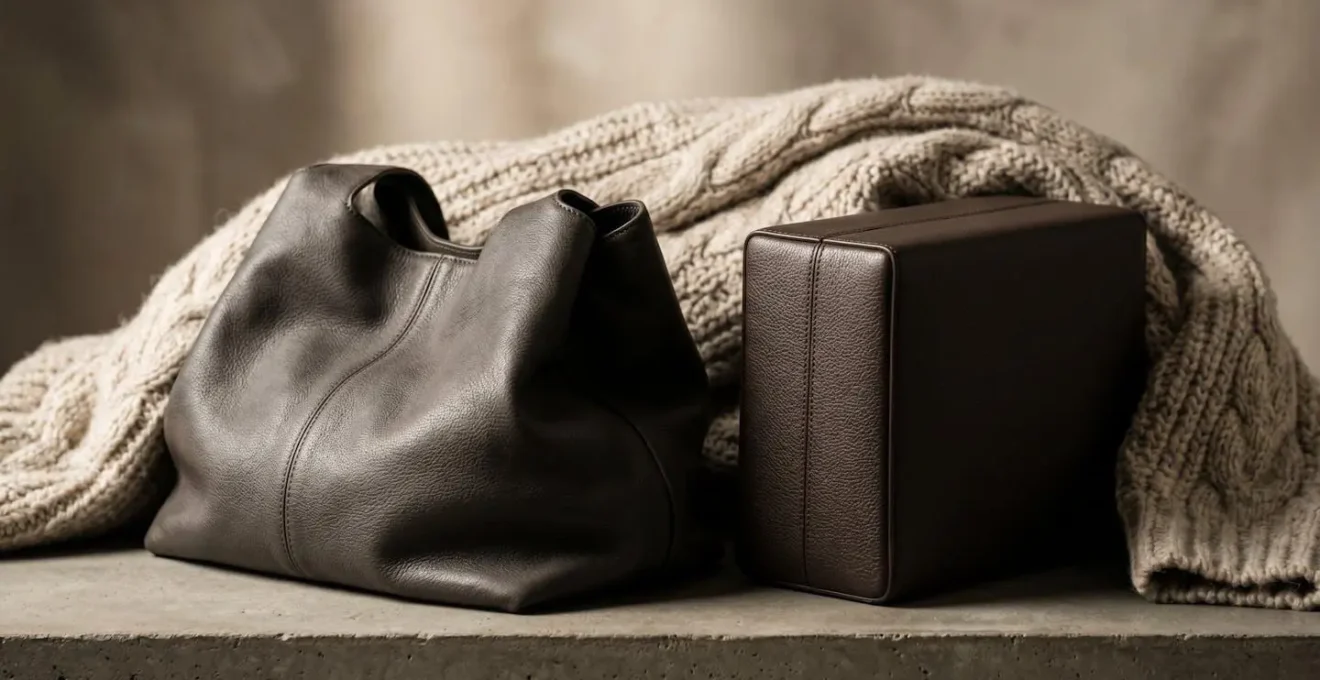
As the image demonstrates, the structured bag maintains its form, providing a crisp line that elevates the soft knitwear. It communicates that the relaxed fit of the clothing is a deliberate style choice, anchored by a professional accessory. This visual and physical stability is the first step toward a bag that serves both your style and your spine. It’s not just about looking put-together; it’s about creating a system that supports postural integrity throughout your day.
Full-grain vs. Bonded Leather: Which handle strap breaks first?
When you’re carrying a laptop, a water bottle, and other daily essentials, the single point of failure on your bag is almost always the handle strap. The material it’s made from is not a minor detail—it’s the core of the bag’s durability and long-term value. The difference between high-quality and low-quality leather is stark, especially when comparing full-grain and bonded leather. Bonded leather is essentially the particle board of the leather world; it’s made from leftover scraps and fibers shredded and glued together onto a backing. As a result, research on leather durability shows it has a very short lifespan and is prone to cracking, peeling, and delaminating under the stress of daily weight.
Full-grain leather, conversely, is the highest quality grade available. It comes from the top layer of the hide and includes all the natural grain, with its dense, long, and interwoven fibers. This natural structure is what gives it incredible tensile strength. It doesn’t just hold weight; it distributes the stress across the entire strap, preventing weak points from forming.
The distinction is best explained by industry experts. As the team at Buffalo Jackson, specializing in leather goods, notes in their guide:
Full-grain leather’s long, interwoven natural fibers distribute weight and stress evenly, while bonded leather has countless weak points that shear under repeated load.
– Buffalo Jackson Leather Experts, Guide to Identifying Real Leather vs. Bonded Leather
Investing in a bag with full-grain leather straps is a direct investment in reliability. While the initial cost is higher, it ensures your bag won’t fail you at a critical moment. A bonded leather strap is almost guaranteed to break first, often within a few years of regular use, making it a poor choice for any professional who relies on their bag daily.
How to organize a tote without a zipper so nothing falls out?
The open-top tote offers effortless access but comes with the constant fear of spills and disarray. The solution isn’t to abandon it for a zippered bag, but to build an intentional internal structure. Effective organization is not just about finding your keys faster; it’s about creating an ergonomic core that stabilizes the bag, improves weight distribution, and prevents items from shifting and falling out. By strategically placing items, you transform a shapeless carry-all into a secure, well-balanced tool.
The key is to use a system that creates internal « walls » and anchors weight correctly. Heavy items like a laptop should be placed against the side of the tote that rests on your body, pulling the bag’s center of gravity inward and preventing it from swinging away from you. Smaller items can be grouped into pouches, which not only compartmentalize but also add to the internal structure. This method turns your tote from a chaotic space into a modular and secure system.
By following a few simple steps, you can secure the contents of any open tote, ensuring nothing falls out while making everything easier to access. This practical approach combines principles of physics and smart organization for a truly functional bag.
Your Action Plan: The 5-Step Method to Secure an Open Tote
- Stabilize the Center of Gravity: Place heaviest items (laptop, water bottle) against the side that rests against your body. This prevents the bag from tilting outward and spilling its contents.
- Use a Modular Pouch System: Separate items into three distinct pouches (e.g., tech accessories, personal items, wallet/cards). This allows for flexible, grab-and-go organization.
- Create Internal Structure: Position the pouches vertically within the tote. Their upright forms act as soft « walls, » preventing other items from shifting and tumbling around.
- Secure the Opening: If your tote has them, always use the internal magnetic clasps or hook closures. This is your first line of defense against accidental spills if the bag is knocked over.
- Install a Key Leash: Attach a key leash or a ‘keyfinder’ clip to an interior loop or handle. This eliminates the need to dig through the bag, which can destabilize the organized contents.
This method doesn’t just organize; it re-engineers your tote from the inside out, providing the security of a zippered bag with the easy access of an open-top design. It proves that with the right system, any bag can be made both practical and polished.
The shoulder carrying mistake that causes tension headaches
For many professionals, a persistent, dull ache at the base of the neck or a recurring tension headache is an accepted cost of carrying a work bag. However, this pain is often the direct result of a simple, correctable mistake: how you position the strap on your shoulder. Most people let the strap slide toward the shoulder’s edge. This forces the trapezius muscle—the large muscle running from your neck to your shoulder—into a state of constant, low-grade contraction to prevent the bag from falling off. This sustained tension restricts blood flow and is a primary cause of both neck pain and tension headaches.
Indeed, ergonomics research on handbag carrying reveals that this constant muscle engagement is a significant trigger for pain. The body isn’t designed for this type of prolonged, asymmetrical load. The correct way to carry a shoulder bag is to place the strap closer to your neck, allowing it to rest on the fleshy, muscular part of the trapezius rather than on the bony edge of the shoulder joint.
Case Study: The Biomechanics of Bag-Induced Headaches
A comprehensive review of studies on bag-carrying methods found a direct link between single-shoulder bags and musculoskeletal issues. Researchers noted that to prevent a strap from sliding off, the trapezius muscle is forced into a sustained contraction. This not only causes muscle strain but also restricts blood flow, becoming a direct cause of tension headaches and chronic neck pain. The problem is significantly worse when the strap rests near the shoulder’s edge, creating a lever effect that magnifies the muscle strain required to hold the bag in place.
The solution is a conscious adjustment. By deliberately positioning the strap on the muscle belly of the trapezius, you allow the skeleton to support more of the weight, reducing the burden on the muscle. This simple shift can dramatically decrease strain and alleviate a major source of daily pain.

This image illustrates the ideal placement. Notice how the wide strap sits comfortably on the muscle, distributing weight evenly without creating a pressure point. Paired with regularly switching shoulders, this technique is one of the most powerful and immediate ways to make your work bag work for your body, not against it.
3 colors (other than black) that match 90% of office wardrobes
A black bag is the default choice for versatility, but it can sometimes feel heavy or uninspired. Expanding your professional color palette with other powerful neutrals can elevate your style and offer just as much, if not more, versatility. The key is to choose shades that have the same chameleon-like ability to pair with the core colors of a typical office wardrobe: navy, grey, camel, and white. There are three non-black colors that stand out for their ability to match nearly everything while adding a touch of modern sophistication.
The first is Taupe or Mushroom Grey. These complex neutrals sit perfectly between beige and grey, giving them the warmth to pair with earth tones and the coolness to complement blues and charcoals. According to 2024-2026 handbag trend analysis, sophisticated neutral colors like taupe remain a staple for their seasonless, transitional appeal. A taupe bag feels lighter and more contemporary than black but maintains a serious, professional edge.
The second is Deep Burgundy or Oxblood. This rich, saturated color functions as a « colored neutral. » It’s bold enough to add a point of interest but deep enough to feel classic and authoritative. It pairs beautifully with all standard neutrals and adds a layer of richness that looks particularly expensive.
Deep burgundy is the perfect mix of expensive-looking color trends, offering quiet authority that pairs exceptionally well with all standard office neutrals while adding richness and maturity.
– Who What Wear Fashion Editors, 5 Major Handbag Colour Trends for 2024
Finally, a rich Cognac or Saddle Brown is an undeniable classic. This warm, caramel-toned leather brings a touch of timeless, heritage style to any outfit. It looks particularly chic against navy blue and crisp white, and it develops a beautiful patina over time, making it an investment piece that only gets better with age. These three colors provide a complete, polished, and versatile alternative to the standard black bag.
Hoodie vs. Knit Blazer: Where is the line for startup founders?
In the modern workplace, especially within the tech and startup ecosystem, the traditional suit-and-tie uniform is long gone. However, a dress code, even an unspoken one, still exists. For founders, what you wear signals your role, your company’s culture, and how seriously you take your business. The line between « approachable builder » and « credible leader » is often drawn by the choice between a hoodie and a knit blazer. While both can be appropriate, the context is everything. A hoodie can signal you’re a hands-on coder, while a blazer communicates executive authority.
The hoodie is the unofficial uniform of the tech world, signifying a focus on product over presentation. In an internal meeting with your engineering team, a high-quality merino wool hoodie says « I’m one of you, focused on the work. » However, wearing that same hoodie to an investor pitch can send a different message: « I’m still in student mode, not yet a business leader. »
The knit blazer, on the other hand, is the perfect modern hybrid. It offers the structure of a traditional blazer with the comfort of a cardigan. It instantly elevates a simple t-shirt or jeans, signaling professionalism without appearing stuffy or corporate. For client-facing meetings or investor pitches, the knit blazer is almost always the safer, more powerful choice. It shows you understand the nuances of business presentation.
Navigating this requires a founder to be a code-switcher, not just in language but in dress. The key is to assess the audience and the objective of every meeting. The following matrix, based on an analysis of professional attire signals, breaks down the perception of each choice in common startup scenarios.
| Context | Hoodie Signal | Knit Blazer Signal | Recommended Choice |
|---|---|---|---|
| Internal team meetings | « I’m in the trenches, building » | « I’m overcompensating » | Hoodie (quality merino/cashmere) |
| Investor pitch meetings | « Still in student mode » | « I’m leading a business » | Knit Blazer (structured fabric) |
| Client-facing events | « Casual, not serious » | « Professional authority » | Knit Blazer |
| Coding/work sessions | « Focused on product » | « Trying too hard » | Hoodie |
| Industry conferences | « Tech insider » | « Polished professional » | Context-dependent: Tech = Hoodie; Corporate = Blazer |
Ultimately, the choice is a strategic one. A founder’s wardrobe is part of their personal brand, and understanding when to deploy the hoodie versus the blazer is a subtle but critical business skill.
Backpack vs. Crossbody: Which shifts the vibe from student to pro?
While a tote bag is a classic professional choice, the modern workplace has become more accepting of alternative styles, particularly backpacks. However, not all hands-free options are created equal. The distinction between a « student » vibe and a « professional » one often comes down to the choice between a crossbody bag and a well-designed backpack. While a crossbody offers convenience, its typically smaller size and casual wear style can often read as informal or ill-equipped for a professional carrying a laptop and other work essentials.
A slouchy, canvas crossbody worn low on the hip sends a signal of carefree, casual movement—perfect for a weekend, but less so for a client meeting. In contrast, a modern, structured backpack in a premium material like leather immediately projects an image of a prepared, mobile professional. The dual-shoulder design not only provides superior ergonomics for carrying a heavy load but also creates a more symmetrical, balanced, and authoritative silhouette.
The single fastest visual cue that separates a « student » bag from a « professional » one is the quality of its design details, particularly the hardware.
Study: Hardware Quality as a Professionalism Indicator
An in-depth analysis of professional backpacks found that hardware is the most immediate indicator of a bag’s credibility. Professional bags consistently utilize minimalist, high-quality hardware, such as matte black or gunmetal zippers and clasps with subtle or no branding. In contrast, student-oriented bags often feature shiny plastic buckles, prominent logos, and flimsy zippers. This design detail alone can shift the perception from « casual » to « urban professional. » The research highlighted that a structured leather backpack, worn high and snug on both shoulders, signals preparedness, while a slouchy crossbody signals a more casual intent.
Therefore, to shift the vibe from student to pro, the choice is clear. A structured, minimalist backpack made from quality materials is far superior to a casual crossbody. It demonstrates that your choice was driven by both function and a keen sense of professional style, marking you as someone who is organized, mobile, and serious about their work.
Key Takeaways
- A bag’s structure is the most critical factor, providing a « visual anchor » for style and promoting better posture for ergonomics.
- Material quality is a non-negotiable signal of professionalism; full-grain leather and minimalist metal hardware instantly elevate a bag over bonded leather and plastic.
- Strategic internal organization is not just for tidiness—it creates a stable « ergonomic core » that prevents spills and improves weight distribution.
How to Look Polished in Jeans and Sneakers for a Casual Client Meeting?
Dressing for a casual client meeting is a balancing act. You want to appear approachable and modern, but also polished and authoritative. The combination of jeans and sneakers can easily lean too casual if not executed with clear intention. The secret to looking polished in this scenario is not about a single item, but a holistic formula where every element signals quality and deliberate choice. This concept of « intentional casualness » ensures your relaxed attire is interpreted as a confident style choice, not carelessness.
The foundation of this look rests on the quality of your basics. This means dark-wash, perfectly fitting jeans with no rips or excessive distressing, paired with minimalist leather sneakers that are impeccably clean. Worn-out gym trainers will immediately undermine the entire outfit. Once this high-quality base is established, the next layer is the key to elevating the look from casual to professional.
The « 3-Layer Polish Formula » provides a simple yet effective framework for achieving this balance. It’s a systematic approach to building an outfit that is comfortable, practical, and undeniably professional.
- Layer 1 – The Quality Base: Start with dark-wash jeans that fit perfectly and minimalist leather sneakers (not gym shoes) that are clean and well-maintained. This foundation must be flawless.
- Layer 2 – The One-Piece-Luxury Rule: Anchor the casual base with one undeniably high-quality, structured item. This could be a tailored knit blazer, a silk blouse, or, most effectively, a premium structured leather bag (either a tote or a backpack). This single piece does the heavy lifting in signaling professionalism.
- Layer 3 – The Detail Finish: Polish the look with considered details. A quality leather belt, a classic watch, and impeccable grooming (neat hair, clean nails) are paramount. These details communicate that your casual dress is a conscious choice.
In a casual outfit, grooming and accessories take on an outsized importance. They are the ultimate signifiers that you have put thought and care into your appearance. The combination of fit, fabric, and finish across all three layers must align to project an image of effortless competence.
Apply these principles to select a work bag and style your outfits with intention. This ensures you choose a piece that not only carries your essentials but also carries you with confidence, comfort, and unwavering professionalism.